
Africa
Zambia is a landlocked country in southern Africa, bordered by the Democratic Republic of the Congo and Tanzania to the north, Malawi and Mozambique to the east, Zimbabwe and Botswana to the south, and Namibia and Angola to the west.
Zambia's name comes from the Zambezi River, which forms much of the country's southern border and is one of Africa's major waterways, home to Victoria Falls, one of the largest waterfalls in the world.
Landscape: Mostly high plateau, with the Zambezi River (and Victoria Falls) along the southern border.
Climate: Tropical, moderated by altitude, with a distinct dry and wet season.
Food: Nshima, a maize porridge, is the everyday staple, typically eaten with a vegetable or meat side dish.
Lusaka became Zambia's capital in 1935, while still under British colonial rule as Northern Rhodesia, chosen for its central, more temperate location and position along the railway line connecting the region's copper mines to the coast. With a population of around 3.3 million, it remains the country's political and economic centre.
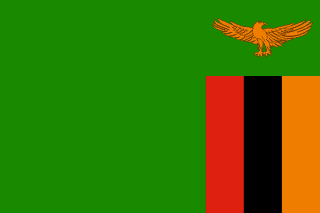
The African fish eagle, known for its distinctive call, is Zambia's national bird, and the country's flag features a unique eagle in flight symbolising the ability to rise above national problems.
Zambian basket weaving, using natural fibres and often incorporating traditional geometric patterns specific to particular ethnic groups, remains a genuinely practised everyday and ceremonial craft. Traditional Zambian pottery and wood carving vary significantly by region, reflecting the country's more than 70 distinct ethnic groups.
Victoria Falls, shared with Zimbabwe and known locally as 'the smoke that thunders,' is Zambia's most significant natural landmark and one of the largest waterfalls in the world by combined width and height. The Kafue National Park, one of the largest in Africa, protects a vast and relatively undeveloped wilderness area.
Zambia's South Luangwa National Park is renowned for walking safaris and significant leopard populations, and the Zambezi River supports large populations of hippopotamuses and Nile crocodiles.
Zambia is overwhelmingly Christian, and unusually for an African country, Christianity is formally declared in the constitution as the country's official religion, alongside guaranteed freedom for other beliefs. Traditional ceremonies, including the Kuomboka ceremony marking the Litunga's (Lozi king's) seasonal move to higher ground, remain genuinely observed cultural events drawing large public participation each year.
Zambia is one of Africa's largest copper producers and exporters, with the mineral forming the overwhelming majority of the country's export revenue.
Independence Day on October 24th marks 1964, when Zambia gained sovereignty from British colonial rule as Northern Rhodesia. Youth Day in March celebrates the country's young population, and Africa Freedom Day on May 25th, shared with several other African nations, commemorates the founding of the Organisation of African Unity and the wider continental push for decolonisation. Zambia's Heroes Day and Unity Day, held together in July, honour the country's independence-era leaders.
Football holds the largest domestic following in Zambia by a wide margin, the national team's 2012 Africa Cup of Nations victory, won in Gabon near the site of a devastating 1993 plane crash that killed much of the national team, treated as an especially emotional and significant national achievement. Boxing has also historically produced notable Zambian competitors. Zambian rugby and netball have also grown in domestic popularity in recent years.
Zambia is a presidential republic, with a President serving as both head of state and government, elected for a five-year term. The country is widely regarded as one of Africa's more stable democracies, having experienced several peaceful transfers of power between political parties since the return of multi-party politics in 1991. Zambia's copper wealth remains central to the national economy despite periodic price volatility.
Mafinga Central, near the border with Malawi, is Zambia's highest point at 2,339 metres. The lowest point is where the Zambezi River exits the country, sitting around 329 metres above sea level, Zambia's lowest point despite being well above true sea level, since the country is entirely landlocked.
There's no especially close match for Zambia's flag, the green field with a soaring orange eagle and a block of red-black-orange vertical stripes in the fly is distinctive enough in its unusual asymmetric layout, most of the coloured elements deliberately placed off to one side rather than centred, a structure not closely echoed by any other national flag.
Adopted in 1964 at independence, a notably unusual layout with the coloured elements placed in the lower fly corner rather than a traditional stripe or canton design.
Home to Victoria Falls, shared with Zimbabwe, one of the largest waterfalls in the world by width.
Play today's Flagpie →© Flagpie 2026