
Africa
Western Sahara sits on the Atlantic coast of northwestern Africa, bordered by Morocco to the north, Algeria to the northeast, and Mauritania to the east and south, largely covered by the Sahara Desert.
Western Sahara's name is straightforwardly descriptive, referring to its location in the western portion of the Sahara Desert along Africa's Atlantic coast.
Landscape: Almost entirely flat, low desert terrain, part of the Sahara, with a long Atlantic coastline.
Climate: Extremely arid, one of the driest and hottest regions in the world.
Food: Traditional Sahrawi cuisine relies heavily on dates, camel milk, and meat, reflecting the region's historic nomadic Bedouin culture.
Laayoune functions as the territory's largest city and administrative centre under Moroccan control, though the Sahrawi Arab Democratic Republic, the partially recognised government representing Sahrawi independence claims, designates a location further inland as its intended capital. The territory's political status remains one of the most significant unresolved decolonisation disputes in Africa.
The camel remains deeply tied to Sahrawi nomadic identity and the region's historic desert trading and herding traditions, predating the territory's more recent and ongoing political disputes.
Sahrawi weaving and leatherwork, tied to a long history of nomadic Bedouin life across the Sahara, remain practised both within the territory and among Sahrawi refugee communities living in camps in neighbouring Algeria. Traditional Sahrawi tea preparation, involving a specific three-glass ceremony similar to customs found elsewhere in the wider Saharan region, remains a genuinely significant daily social practice.
The Moroccan Wall, an extensive series of berms built during the conflict over the territory's status, divides Western Sahara and remains one of the longest continuous defensive structures in the world, a stark reflection of the territory's unresolved political situation.
Western Sahara's coastal waters, rich in fish stocks, support significant seabird populations, and the territory's desert interior holds species adapted to extreme aridity, similar to those found across the wider Sahara.
The Sahrawi people are overwhelmingly Sunni Muslim, and Sahrawi cultural identity remains closely tied to Bedouin nomadic heritage, significantly shaped in recent decades by displacement and refugee experience for a substantial portion of the population. A significant Sahrawi refugee population continues to live in camps near Tindouf, Algeria, decades after the territory's disputed status first displaced them.
Western Sahara's economy centres significantly on phosphate mining and fishing, though the territory's disputed political status significantly complicates formal international trade recognition and data.
Proclamation Day on February 27th marks 1976, when the Sahrawi Arab Democratic Republic was declared by the Polisario Front, the movement representing Sahrawi independence claims, though the territory's actual governance and recognition remain genuinely contested internationally. Given the Sahrawi population's overwhelmingly Muslim identity, Eid al-Fitr and Eid al-Adha are both significant observances, both within the Moroccan-administered territory and among Sahrawi refugee communities. Sahrawi refugee communities mark Martyrs' Day honouring those who died during the territory's prolonged conflict.
Football holds a significant following among Sahrawis both within the territory and in refugee camps in Algeria, though the disputed political status of Western Sahara has significantly limited formal international sporting recognition and competition for any representative Sahrawi team.
Western Sahara's political status remains one of the most significant unresolved decolonisation disputes in the world, with Morocco controlling and administering the majority of the territory while the Polisario Front's Sahrawi Arab Democratic Republic, recognised by a number of countries and the African Union, claims sovereignty over the whole territory, a dispute that has remained unresolved for decades despite periodic international mediation efforts. The territory's phosphate reserves and rich Atlantic fishing grounds remain significant economic resources amid its disputed status. The territory's status remains a recurring subject of United Nations Security Council discussion.
Western Sahara's highest point sits at around 805 metres in the territory's eastern hills. The lowest point sits at sea level along the territory's Atlantic coastline. Western Sahara's terrain is overwhelmingly flat desert, part of the wider Sahara.
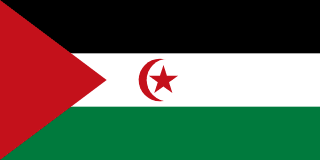
Palestine, Jordan, and several other Arab nations all use the same red-black-white-green Pan-Arab colour combination the Sahrawi flag does, tracing back to the 1916 Arab Revolt flag, with Western Sahara's own red crescent and star set against the white stripe distinguishing it from its regional cousins' differently arranged versions. The territory's flag remains functionally identical to several other Pan-Arab tricolour designs from the wider region.
Adopted in 1976 by the Sahrawi independence movement, based on the same Pan-Arab colour tradition used across the region.
One of the most sparsely populated territories on Earth, largely covered by the Sahara Desert.
Play today's Flagpie →© Flagpie 2026