
Asia
Vietnam stretches along the eastern coast of the Indochinese Peninsula in Southeast Asia, bordered by China to the north and Laos and Cambodia to the west, with a long coastline on the South China Sea.
Vietnam's name combines 'Viet,' referring to the Việt people, with 'Nam,' meaning south, reflecting the country's position relative to China, with which it shares a long and often contentious history. The name in roughly its current form has been used since the early 19th century.
Landscape: Long and narrow, with mountainous terrain in the north and northwest, and the fertile Red River and Mekong River deltas at each end.
Climate: Tropical in the south, more temperate with distinct seasons in the north.
Food: Phở, a noodle soup, is Vietnam's best known dish internationally, alongside bánh mì, a baguette sandwich reflecting the country's period of French colonial rule.
Hanoi has served as Vietnam's capital for most of the last thousand years, first as capital of imperial dynasties, later reinstated as capital of the reunified country after 1976. With a population of around 8 million, it retains a distinctly older character than Ho Chi Minh City in the south, with a well-preserved Old Quarter dating back centuries.
The lotus flower holds deep cultural and spiritual significance in Vietnam, tied to Buddhist symbolism of purity rising from mud, and is widely regarded as the country's unofficial national flower. The Vietnamese dragon, distinct in style from Chinese depictions, appears throughout traditional Vietnamese art and architecture.
The áo dài, a long fitted tunic worn over trousers, is Vietnam's most recognised traditional garment, still commonly worn for formal occasions and by schoolgirls in some regions. Vietnam also has strong traditions in lacquerware and silk weaving, particularly around the village of Van Phuc near Hanoi.
Hạ Long Bay, with its thousands of limestone karst islands rising from emerald water, is Vietnam's most recognised natural landmark and a UNESCO World Heritage Site, alongside the ancient town of Hội An, a well-preserved former trading port.
The saola, a rare forest-dwelling mammal sometimes called the 'Asian unicorn,' was only discovered by scientists in 1992 and is found nowhere else but the Annamite mountains along the Vietnam-Laos border. Vietnam's remaining forests also support several primate species found nowhere else in the world.
Vietnam blends Buddhist, Confucian, and Taoist traditions, often practised together rather than as separate exclusive religions, alongside a significant Catholic minority dating back to French colonial influence.
Vietnam has become a major global exporter of electronics, textiles and footwear, and coffee, of which it's the world's second-largest producer, with manufacturing growing rapidly there in recent decades.
Tết, the Vietnamese Lunar New Year, is by far the country's most significant holiday, involving days of family reunions, ancestral veneration, and a nationwide pause in business and travel similar in scale to Chinese New Year. National Day on September 2nd marks Ho Chi Minh's 1945 declaration of independence from French colonial rule, and Hùng Kings' Festival honours Vietnam's legendary founding dynasty.
Football is Vietnam's most popular sport by a wide margin, with the national team's various regional tournament successes treated as major national events, and badminton and martial arts, particularly Vovinam, a Vietnamese-developed fighting style, also carry genuine cultural significance.
Vietnam is a one-party socialist republic governed by the Communist Party of Vietnam, with a National Assembly serving as the country's legislature, though the Party's own internal structures hold the real decision-making authority. The country reunified under communist rule in 1975 following decades of conflict, and has since pursued a distinctive blend of continued one-party political control alongside significant market-based economic reform since the late 1980s. Vietnam holds elections for its National Assembly, though candidates are heavily vetted through Communist Party-affiliated bodies, limiting genuine multi-party competition.
Fansipan, in the country's northwest, is Vietnam's highest point at 3,147 metres, sometimes called the 'Roof of Indochina,' and is now accessible by cable car as well as traditional trekking routes. The lowest point sits at sea level along Vietnam's long coastline, including the low-lying Mekong Delta in the south.
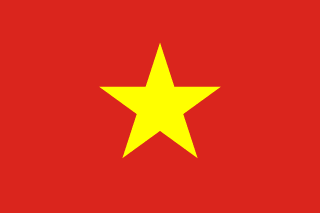
China's flag shares the same red field with a golden star that Vietnam's does, though China's design includes four smaller stars alongside the large one, while Vietnam uses a single larger star alone, similar enough at a glance that the two are genuinely easy to confuse. North Korea also uses red with a star, though its flag's blue and white stripes make the overall design different enough to be less likely mixed up with Vietnam specifically.
Adopted in 1955 in North Vietnam, becoming the flag of the whole country after reunification in 1976, unchanged since.
Has one of the longest coastlines relative to its land area in Southeast Asia, and extraordinary freshwater biodiversity.
Play today's Flagpie →© Flagpie 2026