
Oceania
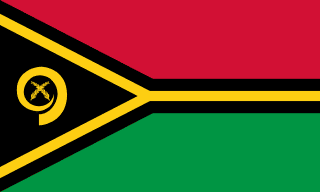
Vanuatu is an archipelago of roughly 80 islands in the South Pacific, sitting west of Fiji and east of Australia.
Vanuatu's name means 'our land' or 'our land stands' in a local Bislama-influenced construction, chosen upon independence in 1980 to replace the colonial name New Hebrides.
Landscape: An archipelago of roughly 80 volcanic islands, mountainous and heavily forested with several active volcanoes.
Climate: Tropical, warm year-round with a wet season and cyclone risk.
Food: Laplap, a dish made from grated root vegetables baked with coconut cream, is widely considered the national dish.
Port Vila has served as Vanuatu's capital since colonial times, when the islands were jointly administered by both Britain and France under an unusual shared arrangement known as a condominium. With a population of around 51,000, it remains the country's dominant commercial and political centre.
The boar's tusk, worn as a traditional symbol of prosperity and status in Melanesian culture, appears on Vanuatu's flag and remains a genuinely significant cultural symbol, and the namele leaf, appearing alongside it, represents peace.
Vanuatu's land diving ritual on Pentecost Island, in which men leap from tall wooden towers with vines tied to their ankles, is considered a precursor to modern bungee jumping and remains a genuinely practised traditional ceremony tied to the yam harvest. Vanuatu's sand drawing tradition, used to convey stories, genealogies, and messages between islands with different spoken languages, is recognised by UNESCO as a significant and unusual communication art form.
Mount Yasur, one of the most accessible active volcanoes in the world, allows visitors to observe eruptions from remarkably close range, and the underwater wreck of the SS President Coolidge, a former ocean liner sunk during the Second World War, is one of the most significant wreck diving sites in the world.
Vanuatu's coral reefs and forests support the flying fox and numerous bird species, and the surrounding waters are known for exceptional visibility and marine biodiversity attracting divers internationally.
Vanuatu is overwhelmingly Christian, though traditional kastom (custom) practices, including land diving and other ceremonial traditions, remain genuinely significant and actively practised alongside Christianity across the archipelago's many distinct island communities.
Vanuatu's economy relies significantly on tourism and agricultural exports including kava and copra, alongside a notable offshore financial services and citizenship-by-investment sector.
Independence Day on July 30th marks 1980, when Vanuatu gained sovereignty from the unusual joint British-French colonial administration known as a condominium. Custom Chief's Day in March honours traditional tribal leadership, reflecting the continued genuine significance of kastom (custom) alongside the modern state across Vanuatu's many distinct island communities. Vanuatu's Family Day reflects the strong cultural emphasis on extended kinship networks across the islands.
Football holds the largest domestic following in Vanuatu, and the country's traditional land diving ritual on Pentecost Island, considered a precursor to modern bungee jumping, remains a significant cultural practice tied to the yam harvest rather than a conventional sport, though it draws comparable levels of community participation and pride. Vanuatu athletes have also competed in beach volleyball and boxing at international level. Vanuatu athletes have also competed in judo at the Pacific Games.
Vanuatu is a parliamentary republic, with a President elected by an electoral college serving a largely ceremonial role and a Prime Minister holding real executive power, accountable to a single-chamber parliament. The country's unusual history as a jointly administered British-French condominium before independence left a lasting dual linguistic and legal legacy still visible in Vanuatu's institutions today. Vanuatu's economy relies significantly on tourism, agriculture, and a modest offshore financial services sector.
Mount Tabwemasana is Vanuatu's highest point at 1,879 metres. The lowest point sits at sea level around the country's many volcanic islands. Vanuatu's volcanic terrain includes several still-active volcanoes across its scattered islands.
There's no especially close match for Vanuatu's flag, the black Y-shaped band bordered in yellow, dividing red and green triangular fields, with a boar's tusk and crossed leaves at the centre, is one of the most visually distinctive national flags in the world, that boar's tusk symbol specifically tied to traditional Melanesian notions of prosperity. The boar's tusk emblem is unique among all Pacific Island nations' flags.
Designed by Kalontas Malia.
Adopted in 1980 upon independence from joint British and French rule, one of the few national flags to feature a boar's tusk, a traditional symbol of prosperity in Melanesian culture.
An archipelago of roughly 80 islands, formerly known as the New Hebrides before independence in 1980.
Play today's Flagpie →© Flagpie 2026