
South America
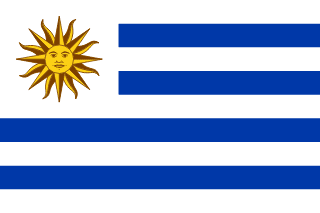
Uruguay is a small country on the southeastern coast of South America, bordered by Brazil to the north and Argentina across the Río de la Plata to the west, with the Atlantic Ocean to the south and east. It's named after the Uruguay River.
Uruguay's name comes from the Uruguay River, which forms part of the country's western border, with roots in the Guaraní language possibly referring to a type of bird or shellfish found along the riverbanks.
Landscape: Mostly low, rolling grassland (pampas), with a coastline on the Río de la Plata and the Atlantic Ocean.
Climate: Temperate, with warm summers and mild winters, no extreme seasons.
Food: Asado, a barbecue tradition shared with Argentina, is central to Uruguayan cuisine, alongside chivito, a large steak sandwich.
Montevideo was founded by the Spanish in 1724 partly to establish a defensive military position against Portuguese expansion from neighbouring Brazil. With a population of around 1.4 million across the metropolitan area, close to half the country's total population, it remains overwhelmingly Uruguay's dominant city.
The southern lapwing, a distinctive crested bird, is closely associated with Uruguay, and the ceibo flower, shared symbolically with Argentina, holds similar national significance on both sides of the Río de la Plata.
Uruguayan gaucho culture, shared with Argentina, has shaped significant leatherwork and silver craft traditions, and mate gourd and bombilla (metal straw) making remains a genuinely practical daily craft given how central drinking mate is to Uruguayan life. Uruguayan tango, though often associated primarily with Argentina, actually developed in parallel across both sides of the Río de la Plata and remains genuinely performed and taught in Montevideo today.
Colonia del Sacramento, a well-preserved Portuguese colonial town founded in 1680, is a UNESCO World Heritage Site, and Palacio Salvo in Montevideo was once the tallest building in South America upon its completion in 1928. Punta del Este, a resort city known for its modern architecture and beaches, has become one of South America's most fashionable coastal destinations.
Uruguay's grassland plains support significant bird populations, including the southern lapwing and rhea, a large flightless bird related to the ostrich, and its coastline is an important site for sea lion colonies.
Uruguay is notably one of the most secular countries in Latin America, with church and state formally separated since 1917, well ahead of most neighbouring countries, and religious observance remains comparatively low.
Uruguay is a significant exporter of beef, soybeans, and wool, with cattle ranching forming a historically central part of the country's economy and cultural identity.
Independence Day on August 25th marks 1825, when Uruguay declared independence during a prolonged struggle involving both Brazil and Argentina over control of the region. Constitution Day on July 18th marks the 1830 adoption of Uruguay's first constitution, and Día del Patrimonio in September celebrates national heritage with free access to museums and historic sites nationwide. Carnival in Uruguay is among the longest in the world, stretching over 40 days and featuring the distinctly Uruguayan candombe drumming tradition.
Football holds a place in Uruguayan national identity disproportionate to the country's small population, Uruguay having won the very first World Cup in 1930 and again in 1950, the latter delivered as a stunning upset over host nation Brazil, an event still referenced in Uruguayan culture today as the Maracanazo. Rugby and basketball also draw significant domestic followings. Uruguayan basketball also holds a long competitive history, with the country among South America's earliest organised leagues.
Uruguay is a presidential republic, with a President serving as both head of state and government, elected for a single five-year term. The country is widely regarded as one of Latin America's most stable and socially progressive democracies, having been an early adopter of measures including same-sex marriage and cannabis legalisation. Uruguay's compulsory voting system, similar to several other Latin American nations, consistently produces high electoral turnout.
Cerro Catedral is Uruguay's highest point at just 514 metres, reflecting the country's generally flat, rolling grassland geography. The lowest point sits at sea level along Uruguay's coastline on the Río de la Plata and Atlantic Ocean.
Argentina's flag shares Uruguay's exact blue-and-white palette and the same golden Sun of May emblem, tracing back to a shared origin in the 1810 revolution both countries' independence movements grew from, though Argentina's simpler design lacks Uruguay's additional horizontal stripes, making the two genuinely easy to mix up despite that structural difference.
Adopted in 1830 shortly after independence, based directly on the design of the flag of the United States.
One of the first countries in the world to legalise the production and sale of cannabis nationwide.
Play today's Flagpie →© Flagpie 2026