
Europe
The United Kingdom occupies most of the British Isles off the northwestern coast of continental Europe, made up of England, Scotland, Wales, and Northern Ireland, the only part sharing a land border, with the Republic of Ireland.
The 'United Kingdom' name reflects its literal formation, a political union of separate kingdoms, England, Scotland, and eventually all of Ireland, later just Northern Ireland, formalised through a series of Acts of Union starting in 1707. 'England' itself derives from the Angles, a Germanic people who settled the region in the early medieval period, their name meaning 'land of the Angles.'
Landscape: A mix of rolling countryside, coastline, and highlands, with Scotland's mountains, Wales' valleys, and England's lowlands each distinct.
Climate: Temperate and famously changeable, mild summers, cool winters, and rain spread fairly evenly across the year rather than concentrated in one season.
Food: Fish and chips is the best known dish abroad, alongside a Sunday roast and, more recently, a curry, now genuinely one of the country's most popular meals.
London has been a major settlement since Roman times, founded as Londinium around 43 AD, and became England's political centre well before the modern United Kingdom existed. With a population of around 9 million across Greater London, it's known as much for its financial sector, historically one of the world's largest, as for its royal and parliamentary institutions, which have sat there for centuries.
Each of the UK's constituent nations has its own emblem rather than one shared national symbol: the rose for England, the thistle for Scotland, the daffodil (or leek) for Wales, and the shamrock for Northern Ireland. The lion appears widely in British royal heraldry and is often treated as an unofficial national animal.
Tartan and tweed are strongly associated with Scottish dress specifically, with individual tartan patterns historically tied to particular clans. England has long traditions of woollen textiles and, more recently, a strong reputation in tailoring, particularly around London's Savile Row.
Stonehenge, a prehistoric monument whose exact purpose is still debated, is among the country's oldest and most visited sites. The Tower of London and Edinburgh Castle both trace back close to a thousand years, and Buckingham Palace remains the monarch's official London residence.
The red fox and European badger are among the UK's most recognisable native mammals, while the puffin nests in large colonies along parts of the Scottish and Welsh coastline. Much of the UK's larger native wildlife, wolves and bears among them, was hunted to extinction centuries ago, leaving a landscape now dominated by smaller mammals and birds.
The Church of England is the country's established church, with the monarch formally serving as its head, though actual religious observance has declined substantially in recent decades. The UK is home to significant Muslim, Hindu, Sikh, and Jewish communities, concentrated particularly in larger cities.
The UK exports significant amounts of financial and business services, alongside pharmaceuticals, machinery, and cars, and London remains one of the world's largest financial centres for international trade and banking.
Bonfire Night on November 5th commemorates the failed 1605 Gunpowder Plot to blow up Parliament, marked with fireworks and bonfires across the country, a genuinely unusual holiday celebrating the failure of an assassination attempt rather than a victory. Christmas and Boxing Day remain the most widely observed holidays, and Remembrance Day on November 11th honours those who died in past conflicts, marked with a two-minute silence and red poppies worn nationwide in the lead-up.
Football (soccer) was codified in England in 1863 and remains the UK's most popular sport by a wide margin, though rugby, cricket, and tennis, the latter home to Wimbledon, all carry deep national significance too. Scotland is widely credited as the birthplace of golf, with the sport documented there as far back as the 15th century.
The UK is a parliamentary constitutional monarchy without a single written constitution, instead relying on a combination of statutes, common law, and long-standing convention. Parliament is split into the elected House of Commons and the largely unelected House of Lords, and the country operates a multi-party system, though it has historically been dominated by the Conservative and Labour parties.
Ben Nevis in Scotland, at 1,345 metres, is the UK's highest point, considerably lower than many other major mountains worldwide but subject to genuinely severe weather given its northern latitude and exposure. The lowest point is the Fens area of eastern England, parts of which sit around 4 metres below sea level, land that has been drained and reclaimed for agriculture since the 17th century.
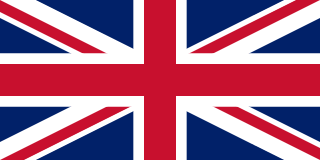
Australia and New Zealand both carry the Union Jack in their own flags' canton, a direct, deliberate acknowledgement of their history as British colonies, though both then add stars in the fly that the UK's own flag doesn't have. Beyond those two, the UK's Union Jack, combining the crosses of England, Scotland, and Ireland, is distinctive enough as a compound design that it isn't easily confused with any flag that doesn't already borrow from it directly.
The Union Jack in its current form dates to 1801, combining England's St George's Cross, Scotland's St Andrew's Cross, and Ireland's St Patrick's Cross into one design after Ireland joined the union.
Home to Stonehenge and dozens of other UNESCO World Heritage Sites across England, Scotland, Wales, and Northern Ireland.
Play today's Flagpie →© Flagpie 2026