
Africa
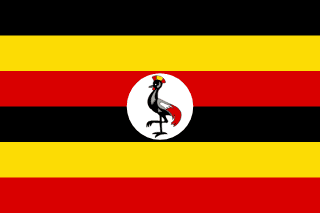
Uganda is a landlocked country in East Africa, bordered by South Sudan to the north, Kenya to the east, Tanzania and Rwanda to the south, and the Democratic Republic of the Congo to the west.
Uganda's name comes from Buganda, the largest and most influential of the kingdoms that existed in the region before British colonisation, whose name was adapted to describe the wider colonial territory and later independent country.
Landscape: A fertile plateau including part of Lake Victoria, the source of the Nile, with mountains along the western border.
Climate: Tropical, generally warm year-round with two rainy seasons.
Food: Matoke, steamed and mashed green bananas, is a staple dish, often served with a groundnut or meat sauce.
Kampala grew from a series of hills historically significant to the Buganda kingdom into Uganda's capital upon independence in 1962. With a population of around 1.7 million, it sits near the shores of Lake Victoria, Africa's largest lake by surface area.
The grey crowned crane, known for its striking golden crest, is Uganda's national bird and appears on the country's flag itself, a distinction shared by very few countries. The song of Africa, or 'Nkima' cultural values, run deep through Ugandan traditional practice, though the crane remains the singular official symbol.
Bark cloth making, a technique using the bark of the mutuba tree, is a distinctly Ugandan craft tradition recognised by UNESCO, historically used for clothing and ceremonial purposes by the Buganda kingdom specifically.
Bwindi Impenetrable Forest, home to roughly half the world's remaining mountain gorillas, is Uganda's most internationally significant natural landmark, and the source of the Nile, where the river begins its journey from Lake Victoria, is another notable site.
Uganda is one of only a handful of countries where mountain gorillas can be seen in the wild, alongside significant populations of chimpanzees and, in its savanna regions, elephants and lions. Queen Elizabeth National Park, spanning a range of habitats from savanna to wetland, holds one of the highest concentrations of hippopotamuses anywhere in Africa.
Uganda is majority Christian, split between Catholic and Protestant traditions, with a significant Muslim minority, and the country recognises dozens of distinct ethnic groups and kingdoms, including Buganda, which retains a ceremonial monarchy alongside the modern republic. Uganda's relationship with its historic kingdoms remains politically significant, with several, including Buganda, Toro, and Bunyoro, retaining recognised ceremonial monarchs today.
Uganda is a significant exporter of coffee, one of Africa's largest producers, alongside gold and fish, particularly from Lake Victoria.
Independence Day on October 9th marks 1962, when Uganda gained sovereignty from British colonial rule. Liberation Day on January 26th marks a more recent and politically significant 1986 date, when the current government took power following a prolonged civil conflict, and NRM Anniversary celebrations reflect the continued political dominance of the movement that emerged from that takeover. Uganda's Martyrs' Day in June commemorates a group of 19th-century Christian converts executed for their faith, now a significant pilgrimage occasion.
Football holds the largest domestic following in Uganda, though the country has found its most significant recent international success in long-distance running, following a similar pattern to neighbouring Kenya and Ethiopia. Boxing has also historically produced notable Ugandan competitors at the international level. Uganda's national football team is nicknamed the Cranes, after the country's national bird featured on its own flag.
Uganda is a presidential republic, with a President serving as both head of state and government. The country has been led by the same President since 1986, one of the longest continuous tenures of any current world leader, and Uganda's political system has drawn both domestic and international scrutiny over the fairness of its more recent elections.
Margherita Peak, on Mount Stanley in the Rwenzori Mountains bordering the Democratic Republic of the Congo, is Uganda's highest point at 5,109 metres, unusually snow-capped and glaciated for a peak so close to the equator. The lowest point is along Lake Albert, sitting around 615 metres above sea level, Uganda's lowest point despite being well above true sea level, since the country is entirely landlocked.
There's no especially close match for Uganda's flag, the black-yellow-red repeating stripe pattern with a central grey crowned crane is distinctive enough as a combination, and Uganda holds the notable distinction of being one of very few national flags in the world to feature an actual bird illustration rather than an abstract or heraldic symbol.
Adopted in 1962 at independence, based on the flag of the political party that led the country to independence.
Home to roughly half of the world's remaining mountain gorillas.
Play today's Flagpie →© Flagpie 2026