
Asia
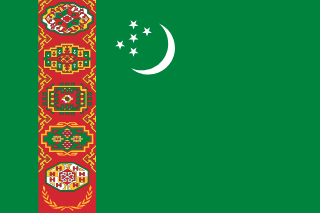
Turkmenistan sits in Central Asia, bordered by Kazakhstan and Uzbekistan to the north, Afghanistan to the southeast, and Iran to the south, with a coastline on the Caspian Sea.
Turkmenistan's name combines 'Turkmen,' the country's dominant Turkic ethnic group, with the Persian suffix 'stan,' meaning 'land of,' with 'Turkmen' itself possibly meaning 'pure Turk' in some historical interpretations.
Landscape: Mostly covered by the Karakum Desert, with mountains along the Iranian border and a Caspian Sea coastline in the west.
Climate: Extremely arid continental, hot summers and cold winters.
Food: Plov, a rice pilaf dish with meat and vegetables, is a shared Central Asian staple and Turkmenistan's most widely eaten dish.
Ashgabat has served as Turkmenistan's capital since the 19th century, though the city was almost completely destroyed by a devastating 1948 earthquake and rebuilt afterward, more recently developed with an extraordinary concentration of white marble buildings that earned it a Guinness World Record for the highest density of white marble-clad buildings in the world. With a population of around 1 million, it remains one of the most unusually monumental capital cities anywhere.
The Akhal-Teke horse, a distinctive breed known for its metallic sheen and endurance, is deeply significant to Turkmen identity, appearing on the national emblem, and traditional Turkmen carpets, with patterns historically representing different tribal groups, appear directly on the country's flag itself.
Turkmen carpet weaving is recognised by UNESCO and considered one of the most significant textile traditions in Central Asia, with five distinct traditional guls (patterns) representing the country's five major tribes appearing on the national flag itself, a rare example of textile craft directly shaping national symbolism.
The Darvaza gas crater, a natural gas field that has been burning continuously since the 1970s, nicknamed the 'Door to Hell,' is Turkmenistan's most internationally distinctive landmark, glowing dramatically in the desert at night.
Turkmenistan's Karakum Desert, covering most of the country, supports species adapted to extreme aridity, and the Akhal-Teke horse breed, one of the oldest domesticated horse breeds in the world, remains bred specifically within the country.
Turkmenistan is majority Muslim, and the country is one of the most closed and tightly controlled in the world, with significant restrictions on media, movement, and public life shaping much of everyday Turkmen society.
Turkmenistan holds some of the largest natural gas reserves in the world, and gas exports, primarily to China, form the overwhelming majority of the country's export revenue.
Independence Day on September 27th marks 1991, when Turkmenistan declared sovereignty following the collapse of the Soviet Union. Neutrality Day on December 12th commemorates the country's officially recognised status of permanent neutrality, a distinctive and central feature of Turkmenistan's foreign policy identity. Turkmenistan's Melon Day each August celebrates the country's prized melons with nationwide festivities. Turkmenistan's Flag Day specifically celebrates the elaborate carpet-pattern design at its centre.
Wrestling and horse riding both hold significant cultural roles in Turkmenistan, the latter tied deeply to the prized Akhal-Teke horse breed, one of the oldest domesticated horse breeds in the world and a powerful national symbol. Football also draws a domestic following, though the country's relative international isolation has limited broader sporting development. Turkmen athletics has also produced competitors at recent Asian Games.
Turkmenistan is a presidential republic, with a President holding near-total executive authority. The country is widely regarded as one of the most closed and tightly controlled nations in the world, with significant restrictions on media, movement, and public life, and Turkmenistan's vast natural gas wealth funds an unusually monumental, marble-heavy capital city. Turkmenistan holds some of the largest natural gas reserves in the world, primarily exported to China.
Ayrybaba is Turkmenistan's highest point at 3,139 metres. The lowest point is the Vpadina Akchanaya depression, sitting around 81 metres below sea level. Turkmenistan's terrain is overwhelmingly covered by the Karakum Desert, with mountains along its southern border.
There's no especially close match for Turkmenistan's flag, the green field bearing a vertical stripe of five traditional carpet guls (patterns), each representing one of the country's major tribes, is one of the only national flags in the world to incorporate actual textile design directly into its official symbolism. The carpet-pattern stripe remains one of the most visually detailed elements found on any national flag worldwide.
Adopted in 1992 after independence, one of the most visually detailed national flags in the world, featuring five traditional carpet-weaving patterns from the country's major tribes.
Home to the Darvaza gas crater, a fire that has burned continuously in the desert since the 1970s, nicknamed the 'Door to Hell.'
Play today's Flagpie →© Flagpie 2026