
Africa
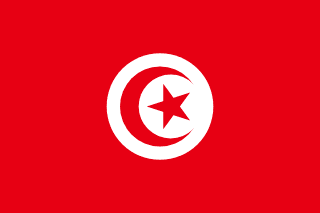
Tunisia sits on the Mediterranean coast of North Africa, the northernmost country on the continent, bordered by Algeria to the west and Libya to the southeast.
Tunisia's name comes from its capital, Tunis, whose own name origin is debated, possibly linked to an ancient Berber or Phoenician goddess associated with the settlement that predates the modern city by well over two thousand years.
Landscape: The Atlas Mountains run through the north, giving way to a central plain and the Sahara Desert in the south, with a long Mediterranean coastline.
Climate: Mediterranean in the north, increasingly arid moving south toward the Sahara.
Food: Couscous is the national dish, often served with a spiced harissa-based sauce that Tunisia is particularly known for.
Tunis has been a significant settlement since Phoenician times, sitting near the ruins of ancient Carthage, and became capital of modern Tunisia following independence from France in 1956. With a population of around 700,000 in the city itself, its historic medina is a UNESCO World Heritage Site.
The eagle appears on Tunisia's coat of arms, tied to the country's modern republican identity, and the jasmine flower is closely associated with Tunisian culture, having lent its name informally to the country's 2011 revolution.
Tunisian pottery, particularly from the town of Nabeul, and hand-woven carpets from Kairouan, one of Islam's holiest cities, both remain significant, actively practised craft traditions.
The ruins of Carthage, once one of the most powerful cities in the ancient Mediterranean before its destruction by Rome, sit just outside modern Tunis, and El Djem's Roman amphitheatre is among the best-preserved of its kind anywhere in the world. The island of Djerba, with its distinctive whitewashed architecture and one of the oldest synagogues in the world, reflects Tunisia's long history of religious coexistence.
Tunisia's northern regions support wild boar and golden jackals, while its southern Saharan territory is home to species adapted to extreme desert conditions, including the fennec fox. Tunisia's Ichkeul National Park, a wetland lake system, is an important wintering site for hundreds of thousands of migratory birds each year.
Tunisia is overwhelmingly Muslim, predominantly Sunni, and is often cited as having one of the more secular and educated populations in the Arab world, a legacy partly shaped by reforms following independence in the 1950s.
Tunisia is a significant exporter of textiles and clothing, olive oil, of which it's one of the world's largest producers, and phosphates.
Independence Day on March 20th marks 1956, when Tunisia gained sovereignty from French colonial administration. Revolution and Youth Day on January 14th marks 2011, when President Zine El Abidine Ben Ali fled the country following weeks of protest, the event widely credited as sparking the broader Arab Spring across the region, and Republic Day on July 25th marks 1957, when Tunisia formally abolished its monarchy. The Sahara Festival in Douz celebrates Bedouin desert culture with camel racing and traditional poetry recitals.
Football holds the largest domestic following in Tunisia by a wide margin, the national team having become a regular fixture at the World Cup among African nations. Handball has also produced significant Tunisian success at the continental and world level, and the country has a strong tradition in road cycling given its varied terrain. Tunisian swimming produced one of Africa's most celebrated Olympic champions in the sport's history.
Tunisia is a presidential republic, with a President holding substantial executive authority alongside a Prime Minister and parliament. The country is widely regarded as the birthplace of the Arab Spring, and its subsequent democratic transition through the 2010s was for some time considered the movement's most successful outcome, though the country's political system has since undergone significant further change under more recent leadership.
Jebel ech Chambi is Tunisia's highest point at 1,544 metres. The Chott el Djerid, a large seasonal salt lake, holds the lowest point at around 17 metres below sea level.
Turkey's flag is Tunisia's closest match by a wide margin, both use a red field with a white crescent and star, and it's not a coincidence, Tunisia's flag was directly influenced by Ottoman-era Turkish design during a period of Ottoman rule, differing mainly in that Tunisia's crescent and star sit within a white circle rather than floating directly on the red field.
Adopted in 1831, one of the oldest continuously used flags in Africa or the Middle East, kept unchanged through independence from France in 1956.
The northernmost country in Africa.
Play today's Flagpie →© Flagpie 2026