
Africa
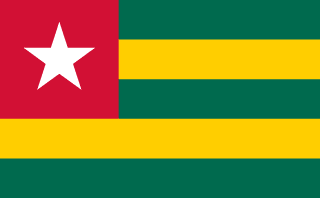
Togo is a narrow country in West Africa, wedged between Ghana to the west and Benin to the east, with Burkina Faso to the north and a short coastline on the Gulf of Guinea to the south.
Togo's name comes from a village on the shore of Lake Togo, whose Ewe-language name means roughly 'behind the lake' or 'near the water,' later extended by German colonisers to describe the entire colonial territory.
Landscape: A narrow country stretching from a short Atlantic coastline north through hills and savanna toward the Sahel.
Climate: Tropical in the south, becoming drier moving north.
Food: Fufu and a spiced tomato-based sauce called sauce d'arachide (peanut sauce) are widely eaten staples.
Lomé has served as Togo's capital since German colonial times, developed as a port town along the Gulf of Guinea coast. With a population of around 840,000, it remains the country's dominant political and commercial centre, sitting close to the border with Ghana.
The lion appears on Togo's coat of arms, and the country's star, positioned inside a canton similar in structure to the layout of the United States flag, represents hope and independence.
Togolese wood carving and traditional bronze casting, particularly among the Ewe people, reflect deep regional artistic heritage, and Togolese kente-style weaving, shared culturally with neighbouring Ghana, remains produced in parts of the country. Traditional Togolese pottery, produced largely by women in specific villages, remains an important everyday craft passed through generations.
The Koutammakou region, home to the Batammariba people's distinctive tower-house architecture (Takienta), is a UNESCO World Heritage Site reflecting a unique and still-inhabited traditional building style found nowhere else.
Togo's Fazao-Malfakassa National Park protects significant savanna and forest habitat, though wildlife populations have faced considerable pressure from habitat loss in recent decades. Togo's Lake Togo lagoon supports significant fish populations central to local fishing communities' livelihoods.
Togo is religiously mixed, with significant Christian, traditional African religious, and Muslim populations, and the country is considered one of the birthplaces of Vodun (voodoo) religious tradition, still widely and openly practised today. Togo's narrow shape, stretching from the coast deep into the interior, gives it an unusually wide range of climate zones and ethnic communities for its size.
Togo is a significant exporter of phosphates and cotton, alongside cement, with the Port of Lomé also serving as a significant regional transhipment hub for neighbouring landlocked countries.
Independence Day on April 27th marks 1960, when Togo gained sovereignty from French colonial rule. Given Togo's significant Christian, Muslim, and traditional African religious populations, a wide range of religious holidays are observed, and Togo is considered one of the birthplaces of Vodun, still widely and openly practised alongside other faiths. Togo's Liberation Day commemorates a significant political transition within the country's post-independence history. Togo's Martyrs Day honours victims of a significant historical political crackdown.
Football holds the largest domestic following in Togo by a wide margin, the national team's qualification for the 2006 World Cup remaining the most significant achievement in the country's sporting history. Traditional wrestling also remains practised across various regional communities. Togolese athletics has also produced regional competitors at continental championships. Togolese boxing has also produced regional competitors at continental level.
Togo is a presidential republic, with a President serving as both head of state and government. The country has been governed by the same family for decades, one of the longest continuous single-family political dominances in Africa, and Togo has faced periodic domestic and international pressure over the fairness of its electoral processes. Togo's phosphate mining and cotton exports remain significant parts of its economy.
Mont Agou is Togo's highest point at 986 metres. The lowest point sits at sea level along Togo's short Atlantic coastline. Togo's narrow, elongated shape gives it a genuinely wide range of terrain from coast to northern savanna.
There's no especially close match for Togo's flag, the alternating green and yellow horizontal stripes with a red canton bearing a white star make it a distinctive combination, that canton-and-star layout structurally similar to the United States's flag design despite using entirely different colours. The alternating stripe pattern with a canton is structurally similar to the American flag despite entirely different colours.
Adopted in 1960 upon independence from France, one of the few African flags to include a star inside a canton similar in structure to the US flag's layout.
One of the narrowest countries in Africa, stretching in a thin strip from the coast inland.
Play today's Flagpie →© Flagpie 2026