
Asia
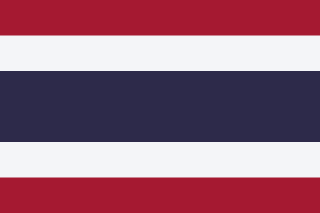
Thailand sits at the centre of mainland Southeast Asia, bordered by Myanmar to the west and north, Laos to the north and east, Cambodia to the east, and Malaysia to the south.
Thailand's name means 'land of the free,' a point of particular national pride since it's the only country in Southeast Asia never formally colonised by a European power. The country was called Siam until 1939, when it officially adopted the name Thailand.
Landscape: Central river plains, forested mountains in the north, and a long coastline on both the Gulf of Thailand and the Andaman Sea.
Climate: Tropical, with a hot season, a rainy monsoon season, and a cooler dry season.
Food: Pad thai and tom yum soup are internationally known, built on a distinctive Thai balance of sweet, sour, salty and spicy flavours.
Bangkok became Thailand's capital in 1782 under King Rama I, founder of the current Chakri dynasty, chosen for its position along the Chao Phraya River, which offered both trade access and defensive advantages. With a population of around 10.7 million, it remains overwhelmingly Thailand's dominant city both politically and economically.
The Asian elephant holds deep cultural and historical significance in Thailand, once used in warfare and labour, and remains the country's national animal, with white elephants specifically considered sacred and historically associated with the monarchy. The ratchaphruek, a tree with cascading yellow flowers, is Thailand's national flower and tree.
Thai silk weaving, particularly from the northeast region, has built an international reputation for quality, and traditional Thai classical dance, khon, involves elaborate costumes and masks tied to stories from the Ramakien, Thailand's own version of the Indian Ramayana epic.
The Grand Palace in Bangkok, former residence of the Thai king, houses the Temple of the Emerald Buddha, one of the most sacred sites in Thai Buddhism, alongside Ayutthaya, a former capital and UNESCO World Heritage Site whose ruins reflect its destruction by Burmese invaders in the 18th century.
Thailand is home to Asian elephants, tigers, and significant numbers of endemic bird species, with several national parks specifically protecting remaining forest habitat under increasing development pressure.
Thailand is overwhelmingly Buddhist, specifically Theravada Buddhism, and the religion is deeply woven into daily life, from morning alms-giving to young men temporarily ordaining as monks. The country also has a significant Muslim minority, particularly in its southern provinces.
Thailand is a major exporter of electronics, cars and automotive parts, and rice, among the largest rice exporters in the world, alongside a large and significant tourism industry.
Songkran, the traditional Thai New Year in mid-April, has become internationally famous as a nationwide water fight, though it originated as a gentler ritual of pouring water over Buddha images and elders' hands as a sign of respect and blessing. Loy Krathong, held on the full moon of the twelfth lunar month, involves floating small decorated baskets on rivers and waterways as an offering, one of the most visually striking festivals in the country.
Muay Thai, a striking martial art with centuries of history, is Thailand's national sport and a matter of deep cultural pride, practised both competitively and as a fitness pursuit worldwide today. Football also draws a large domestic following, and sepak takraw, a sport combining elements of volleyball and football played with a rattan ball, is especially popular across Southeast Asia.
Thailand is a constitutional monarchy with a parliamentary system, the King serving as head of state, a role held in particularly high public reverence, while a Prime Minister holds executive authority. The country has experienced numerous military coups since becoming a constitutional monarchy in 1932, a recurring feature of its modern political history, though it has returned to civilian parliamentary rule after each.
Doi Inthanon, in the country's north, is Thailand's highest point at 2,565 metres, cool enough at its summit to occasionally see frost, a genuine rarity in a tropical country. The lowest point sits at sea level along Thailand's coastlines on both the Gulf of Thailand and the Andaman Sea.
Costa Rica's flag uses a similar red-white-blue horizontal striped structure to Thailand's, though with different stripe proportions and an added coat of arms Thailand's flag doesn't carry. The Netherlands and several other countries share Thailand's exact three colours too, though arranged with fewer, wider stripes rather than Thailand's distinctive five-band layout, different enough in structure to avoid real confusion.
The current five-stripe design was adopted in 1917, replacing an earlier flag that featured a white elephant on a red background.
The only country in Southeast Asia never colonised by a European power.
Play today's Flagpie →© Flagpie 2026