
Asia
Tajikistan is a landlocked, mountainous country in Central Asia, bordered by Kyrgyzstan to the north, China to the east, Afghanistan to the south, and Uzbekistan to the west.
Tajikistan's name combines 'Tajik,' referring to the country's Persian-speaking majority ethnic group, with the Persian suffix 'stan,' meaning 'land of,' distinguishing Tajiks linguistically from the Turkic-speaking peoples of neighbouring Central Asian countries.
Landscape: Extremely mountainous, dominated by the Pamir range (sometimes called the 'Roof of the World'), with very little flat land.
Climate: Continental, varying enormously by elevation, hot in the lowland valleys, freezing in the high Pamirs.
Food: Osh, a rice dish with meat, carrots, and onions, shared with other Central Asian countries, is widely considered the national dish.
Dushanbe grew from a small village into Tajikistan's capital during the Soviet era, its name meaning 'Monday' in Persian, referring to a weekly market historically held there. With a population of around 900,000, it retains notable Soviet-era architecture alongside more recent, large-scale monumental construction projects.
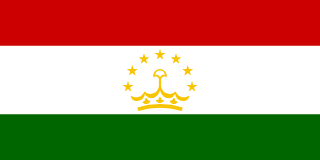
The Marco Polo sheep, with some of the largest spiralling horns of any wild sheep species, is closely tied to Tajikistan's mountainous Pamir region, and the crown appearing on the country's flag reflects both Tajik cultural heritage and the country's mineral wealth.
Tajik silk weaving and embroidery, particularly the colourful chakan needlework tradition, reflect deep Persian-influenced craft heritage, and traditional Tajik felt-making and rug weaving remain practised in more rural mountain communities. Traditional Tajik music, particularly the Shashmaqam classical tradition shared with Uzbekistan, is recognised by UNESCO as significant regional intangible heritage.
The Pamir Mountains, sometimes called the 'Roof of the World,' cover the majority of Tajikistan's territory, and the Fann Mountains offer dramatic alpine lakes and peaks popular with trekkers. The Wakhan Corridor, a narrow strip of Tajik territory stretching toward China, offers some of the most remote and dramatic high-altitude scenery in Central Asia.
The Pamir region supports snow leopards and Marco Polo sheep, both adapted to some of the highest and most extreme mountain terrain inhabited by large mammals anywhere on Earth.
Tajikistan is majority Muslim, predominantly Sunni, with a significant Ismaili Shia population in the Pamir region, and Tajik culture and language remain closely tied to the wider Persian cultural world, distinct from Tajikistan's Turkic-speaking Central Asian neighbours.
Tajikistan is a significant exporter of aluminium and cotton, alongside hydroelectric power, given the country's substantial mountain river systems, though remittances from Tajik migrant workers abroad also form a significant part of the national economy.
Independence Day on September 9th marks 1991, when Tajikistan declared sovereignty following the collapse of the Soviet Union. Nowruz, the Persian spring New Year shared with Iran and several Central Asian neighbours, is celebrated with particular enthusiasm, reflecting Tajikistan's distinct Persian-linked cultural heritage among its Turkic-speaking regional neighbours. Tajikistan's Victory Day in May commemorates the Soviet victory in the Second World War, shared with several post-Soviet states. Tajikistan's Language Day celebrates the Tajik language's distinct Persian roots.
Wrestling and judo both hold significant places in Tajik sporting culture, the country having produced Olympic medallists in both disciplines. Traditional Central Asian horseback games, including buzkashi, shared with neighbouring Afghanistan, remain practised as part of broader cultural heritage. Tajik boxing has also produced notable competitors at continental championships.
Tajikistan is a presidential republic, with a President holding substantial executive authority. The country experienced a devastating civil war from 1992 to 1997 following independence, and Tajikistan's current President has held power continuously since 1994, one of the longest tenures of any post-Soviet leader. Tajikistan's economy relies significantly on aluminium exports and remittances from citizens working abroad.
Ismoil Somoni Peak, formerly known as Communism Peak under Soviet rule, is Tajikistan's highest point at 7,495 metres. The lowest point is along the Syr Darya river valley, sitting around 300 metres above sea level, Tajikistan's lowest point despite being well above true sea level, since the country is entirely landlocked and mountainous. Tajikistan's overwhelmingly mountainous terrain includes the Pamir range, sometimes called the 'Roof of the World.'
There's no especially close match for Tajikistan's flag, the red-white-green horizontal bands topped by a golden crown beneath an arc of seven stars are a distinctive combination, that crown-and-stars emblem specifically representing the unity and friendship of the Tajik people. The crown-and-stars emblem is genuinely unique among all Central Asian nations' flags.
Adopted in 1992 shortly after independence from the Soviet Union.
One of the most mountainous countries on Earth, with the Pamir range, sometimes called the 'Roof of the World,' covering over 90% of its territory.
Play today's Flagpie →© Flagpie 2026