
Asia
Taiwan is an island off the southeastern coast of mainland China, sitting north of the Philippines across the Luzon Strait.
Taiwan's name likely comes from an Indigenous Siraya word referring to the area around modern Tainan, later applied by Chinese and Dutch settlers to the whole island, with the exact original meaning debated among linguists.
Landscape: Mountainous through the centre and east, with a fertile, densely populated plain along the western coast.
Climate: Subtropical to tropical, warm and humid with a typhoon season.
Food: Beef noodle soup and a huge night-market food culture, including dishes like oyster omelettes and bubble tea, define Taiwanese cuisine.
Taipei became the seat of the Republic of China government in 1949, when it relocated there following the Chinese Civil War, though the city itself had already been a significant administrative centre under earlier Japanese colonial rule. With a population of around 2.6 million in the city itself, it remains Taiwan's political, economic, and cultural centre.
The Formosan black bear, found only on Taiwan and distinguished by a distinctive V-shaped mark on its chest, is closely tied to the island's identity, and plum blossoms, blooming even in cold winter conditions, are the national flower, symbolising resilience.
Taiwanese ceramics, particularly from the town of Yingge, and traditional temple woodcarving, reflecting a blend of Chinese, Japanese, and Indigenous Taiwanese influences, remain significant living craft traditions.
Taroko Gorge, a dramatic marble canyon carved by a river through the island's mountains, is Taiwan's most significant natural landmark, and the National Palace Museum in Taipei holds one of the largest collections of Chinese imperial artefacts in the world.
Taiwan's mountainous interior supports the Formosan black bear and the Mikado pheasant, both found only on the island, reflecting its status as a significant biodiversity hotspot despite its relatively small size.
Taiwan is religiously mixed, with Buddhism, Taoism, and folk religious traditions all widely practised, often blended together rather than treated as separate faiths, and the island is home to a small but culturally significant Indigenous Austronesian population predating Chinese settlement by thousands of years.
Taiwan is one of the world's largest producers and exporters of semiconductors, with the island's chip manufacturing industry playing an outsized and globally critical role in modern electronics supply chains.
National Day (Double Ten Day) on October 10th marks the 1911 uprising that led to the founding of the Republic of China, celebrated with fireworks and public festivities across the island. Given Taiwan's significant Buddhist, Taoist, and folk religious traditions, Lunar New Year and Ghost Festival are both widely and distinctly observed. Taiwan's Tomb Sweeping Day in April honours ancestors through family grave-cleaning traditions. Taiwan's Peace Memorial Day commemorates a significant and long-suppressed part of the island's 20th-century history.
Baseball holds a place in Taiwanese national identity matched by few other sports, introduced during Japanese colonial rule and remaining deeply embedded in everyday culture, with the island having produced numerous professional players. Taekwondo and badminton have also produced notable Taiwanese Olympic medallists.
Taiwan operates as a self-governing democracy under the formal name Republic of China, with a directly elected President and a single-chamber Legislative Yuan. The island's political status remains genuinely contested internationally, with mainland China claiming Taiwan as its own territory, making Taiwan's exact international status one of the most significant unresolved geopolitical questions in the world today. Taiwan is one of the world's largest producers of semiconductors, playing an outsized role in global electronics supply chains.
Yu Shan (Jade Mountain) is Taiwan's highest point at 3,952 metres, the highest peak in East Asia outside the Himalayan region. The lowest point sits at sea level around the island's coastline. Taiwan's mountainous interior covers roughly two-thirds of the island, with dense population concentrated along the western coast.
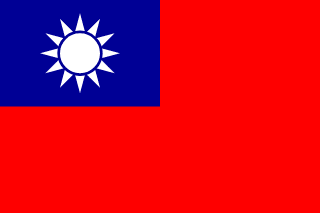
There's no especially close match for Taiwan's flag, the red field with a blue canton bearing a white sun with twelve rays is a distinctive combination, that same flag having represented the Republic of China continuously since 1928, predating the current mainland Chinese government by over two decades. The blue canton and white sun combination is unique among all East Asian nations' current flags.
Adopted in 1928 by the Republic of China government, carried to Taiwan in 1949 when that government relocated there, and unchanged since.
Punches far above its size in biodiversity, packing more species per square kilometre than almost any other place on Earth.
Play today's Flagpie →© Flagpie 2026