
South America
Suriname is the smallest sovereign country in South America, sitting on the northern coast between Guyana to the west and French Guiana to the east, with Brazil to the south.
Suriname's name likely comes from the Surinen, an Indigenous people who inhabited the region before Spanish, then Dutch colonisation, though the exact original meaning of the name has been lost to history.
Landscape: The most densely forested country on Earth, with a narrow coastal plain giving way almost entirely to dense Amazon rainforest.
Climate: Tropical, hot and humid year-round with two wet seasons.
Food: Roti, reflecting the country's large Indian-descended population, is widely eaten alongside pom, a baked casserole made from a local root vegetable.
Paramaribo was founded in the mid-17th century and grew under Dutch colonial rule into Suriname's capital, retaining an unusually well-preserved collection of wooden colonial architecture recognised by UNESCO. With a population of around 240,000, it remains the country's dominant political and economic centre.
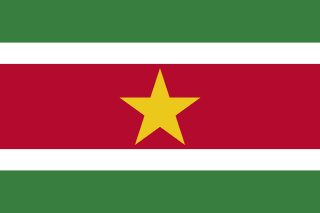
The jaguar appears on Suriname's coat of arms, reflecting the country's extensive rainforest, and the country's flag features a single star representing the unity of all Surinamese people across its notably diverse population.
Surinamese Maroon woodcarving, produced by descendants of enslaved Africans who escaped into the interior rainforest and developed distinct communities, reflects one of the most significant African-diaspora art traditions in the Americas, alongside Indigenous basket weaving and pottery. Traditional Javanese and Indian cultural practices, brought by indentured labourers during Dutch colonial rule, remain distinctly preserved within Suriname's broader multicultural society.
The historic inner city of Paramaribo, with its distinctive Dutch colonial wooden buildings, is a UNESCO World Heritage Site, and the Central Suriname Nature Reserve protects one of the largest expanses of untouched rainforest remaining in South America.
Suriname is the most densely forested country on Earth, with over 90% forest cover, supporting jaguars, giant river otters, and harpy eagles across its largely undeveloped interior.
Suriname is religiously and ethnically extraordinarily diverse for its small population, with significant Hindu, Muslim, and Christian communities reflecting Indian, Javanese, African, and Indigenous heritage, often described as one of the most ethnically mixed countries in the world. Suriname's national motto, 'justice, piety, loyalty,' reflects the country's deliberate emphasis on multicultural coexistence among its diverse population.
Suriname is a significant exporter of gold and, increasingly, oil following major offshore discoveries, alongside bauxite, historically one of the country's most significant mineral resources.
Independence Day on November 25th marks 1975, when Suriname gained sovereignty from the Netherlands. Given Suriname's extraordinary religious diversity, the country officially recognises major holidays across Hindu, Muslim, and Christian traditions, including Holi, Eid, and Christmas, reflecting its genuinely multicultural population. Suriname's Owru Yari (Old Year) celebrations on New Year's Eve feature elaborate firecracker displays nationwide. Suriname's Keti Koti (Emancipation Day) in July commemorates the 1863 abolition of slavery with significant public celebration. Suriname's Indigenous Peoples Day recognises the country's original inhabitant communities.
Football holds the largest domestic following in Suriname, and the country has an unusual sporting connection to the Netherlands, with numerous Surinamese-born or descended players having represented the Dutch national football team over the decades given historical migration between the two countries. Surinamese athletes have historically competed for the Netherlands too, given the countries' shared colonial history. Surinamese judo has also produced competitors at recent Olympic Games.
Suriname is a presidential republic, with a President elected by the National Assembly serving as both head of state and government. The country's significant offshore oil discoveries in recent years are expected to substantially transform its economy, and Suriname's extraordinarily diverse population reflects its history of Dutch, African, Indian, Javanese, and Indigenous settlement. Suriname's bauxite mining and, increasingly, offshore oil exploration remain central to its economy.
Julianatop is Suriname's highest point at 1,286 metres. The lowest point sits at sea level along Suriname's Atlantic coastline. Suriname's terrain is overwhelmingly covered by dense, largely untouched Amazon rainforest.
There's no especially close match for Suriname's flag, the green-white-red-white-green horizontal bands with a large yellow star at the centre are a distinctive combination, that star specifically representing the unity of all Surinamese people across the country's remarkably diverse population. The five-band design with a central star is unique among all South American nations' flags.
Adopted in 1975 upon independence from the Netherlands, replacing an earlier flag that had featured five stars representing the country's main ethnic groups.
The most densely forested country on Earth, with over 90% forest cover.
Play today's Flagpie →© Flagpie 2026