
Asia
Sri Lanka is an island nation in the Indian Ocean, sitting just southeast of India across the Palk Strait.
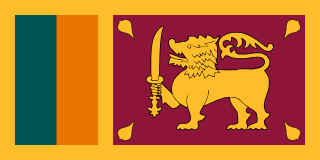
This flag has the highest proportion of saffron of any flag in Flagpie, at 44%.
Sri Lanka's name combines the Sanskrit 'sri,' meaning resplendent or venerable, with 'lanka,' an ancient name for the island itself referenced in Hindu epic literature including the Ramayana.
Landscape: A teardrop-shaped island with a central highland region surrounded by coastal plains.
Climate: Tropical, with a monsoon season that varies significantly between the island's wet southwest and drier north and east.
Food: Rice and curry, often with a wide variety of vegetable and meat curries served together, forms the basis of most Sri Lankan meals.
Sri Lanka has two capitals, Colombo, the commercial capital and largest city, and Sri Jayawardenepura Kotte, the official administrative capital since 1982, a distinction similar in spirit to South Africa's split arrangement. Colombo, with a population of around 750,000 in the city itself, remains the country's dominant economic centre regardless of the formal administrative split.
The Sri Lankan junglefowl, a colourful wild relative of the domestic chicken, is the national bird, and the blue water lily is the national flower, closely tied to Buddhist symbolism on the island.
Sri Lankan traditional dance forms, including Kandyan dance, involve elaborate costumes and masks tied to specific regional and religious traditions, and the island has a long history of gem cutting and trading, particularly sapphires. Sri Lankan mask carving, particularly for traditional exorcism and dance rituals, remains an actively practised craft passed down within specific artisan families.
Sigiriya, an ancient rock fortress built in the 5th century AD atop a dramatic 200-metre column of rock, is Sri Lanka's most famous archaeological site, alongside the sacred city of Kandy, home to the Temple of the Sacred Tooth Relic. Sri Lanka's central highlands, covered in extensive tea plantations, offer some of the most photographed agricultural landscapes in South Asia.
Sri Lanka has one of the highest densities of Asian elephants in the world, and its waters are among the best places globally to see blue whales, the largest animal to have ever lived.
Sri Lanka is majority Buddhist, predominantly Sinhalese, with significant Hindu Tamil, Muslim, and Christian minorities, a diversity that has at times been a source of significant political and ethnic tension in the country's more recent history.
Sri Lanka is a significant exporter of tea, particularly Ceylon tea, one of the most recognised tea brands in the world, alongside garments and rubber products.
Independence Day on February 4th marks 1948, when Sri Lanka (then Ceylon) gained sovereignty from British colonial rule. Sinhala and Tamil New Year, celebrated jointly in mid-April, is one of the few holidays observed together across the country's two largest ethnic communities, and Vesak in May, marking the Buddha's birth, enlightenment, and death on a single shared full moon day, is celebrated with elaborate illuminated displays nationwide. Kandy Esala Perahera, a grand Buddhist procession featuring decorated elephants, is one of Asia's most spectacular annual religious festivals.
Cricket holds an enormous following in Sri Lanka, treated with the same intensity found across much of South Asia, and the country's 1996 World Cup win, achieved with a genuinely innovative and aggressive style of play, remains one of the most celebrated moments in its sporting history. Volleyball is officially designated the national sport, though it draws considerably less everyday attention than cricket.
Sri Lanka is a presidential republic, with a directly elected President holding substantial executive power alongside a Prime Minister and single-chamber parliament. The country experienced a prolonged and brutal civil war between the government and Tamil separatist forces, ending in 2009, whose legacy continues to shape Sri Lankan politics and the relationship between its Sinhalese majority and Tamil minority.
Pidurutalagala is Sri Lanka's highest point at 2,524 metres, though nearby Adam's Peak, considerably lower but far more culturally significant as a pilgrimage site sacred to Buddhists, Hindus, Muslims, and Christians alike, draws far more visitors. The lowest point sits at sea level around the island's coastline.
There's no especially close match for Sri Lanka's flag, the golden lion holding a sword on a maroon field, bordered by orange and green stripes, is distinctive enough as a combination that confusion is essentially unheard of, one of the most visually detailed and unique national flags in the world.
Adopted in 1948 at independence, with stripes added in 1951 and 1972 to represent the country's Tamil and Muslim minorities alongside the original lion symbol.
One of the world's largest producers and exporters of cinnamon, most of it grown on the island for centuries.
Play today's Flagpie →© Flagpie 2026