
Europe
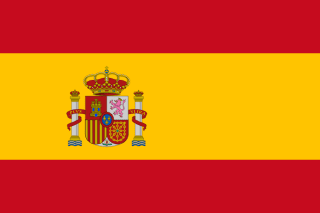
Spain occupies most of the Iberian Peninsula in southwestern Europe, bordered by Portugal to the west and France and Andorra to the northeast, with coastlines on the Atlantic Ocean and the Mediterranean Sea.
Spain's name likely derives from an ancient word, possibly Phoenician, referring to the Iberian Peninsula, though the exact original meaning is debated, with theories ranging from a reference to rabbits to a word for a hidden or northern land.
Landscape: A large central plateau surrounded by mountain ranges, with coastline on the Atlantic and Mediterranean and a notably dry, high interior.
Climate: Mediterranean along the coasts, continental and drier in the central plateau.
Food: Paella, tapas, and jamón (cured ham) are among Spain's best known culinary exports, with huge regional variation across the country.
Madrid became Spain's capital in 1561 under King Philip II, chosen partly for its central location within the Iberian Peninsula rather than any pre-existing political importance, a deliberate decision to place the seat of government at the country's geographic heart. With a population of around 3.3 million, it's now Spain's largest city and financial centre.
The carnation is Spain's national flower, and the bull, while not an official state symbol, is deeply tied to Spanish cultural identity through bullfighting and appears widely in Spanish iconography and branding. The country's national motto, 'Plus Ultra' (further beyond), dates back to the age of Spanish exploration and empire.
Flamenco, encompassing music, song, and dance, originated in Andalusia and remains one of Spain's most internationally recognised cultural exports, alongside traditional dress like the flamenco dress and mantilla lace veil still worn at festivals and formal occasions.
The Alhambra, a Moorish palace and fortress complex in Granada, reflects centuries of Islamic rule over southern Spain and remains one of the country's most visited sites. Sagrada Família in Barcelona, designed by Antoni Gaudí and still under construction more than a century after it began, is another of Spain's defining landmarks.
The Iberian lynx, the world's most endangered wild cat species, is found only in Spain and Portugal, and has been the subject of an intensive, and increasingly successful, conservation breeding programme. The Spanish imperial eagle is similarly found nowhere else in the world.
Spain is historically and still majority Roman Catholic, though religious practice has declined significantly among younger Spaniards in recent decades. The country also carries a distinct regional identity, with Catalan, Basque, and Galician communities each maintaining their own languages and strong cultural traditions.
Spain is a major exporter of cars, machinery, and agricultural products, particularly olive oil, of which it's the world's largest producer, alongside wine and fresh produce.
La Tomatina, held on the last Wednesday of August in the town of Buñol, is one of Spain's most internationally famous festivals, a good-natured mass tomato fight that draws visitors from around the world despite being a fairly small local event by origin. National Day on October 12th marks Columbus's 1492 arrival in the Americas, and Semana Santa (Holy Week) before Easter is marked by elaborate religious processions in cities like Seville.
Football holds an enormous following in Spain, home to some of the most successful and widely supported clubs in the world, and the national team's period of dominance in the late 2000s and early 2010s remains one of the most decorated eras in the sport's history. Bullfighting, though increasingly contested and banned in some regions, remains a significant, if controversial, part of traditional Spanish culture, and tennis has produced some of the sport's most successful modern players.
Spain is a parliamentary constitutional monarchy, with the King serving a ceremonial role and real executive power held by a Prime Minister accountable to Parliament. The country is divided into 17 autonomous communities with significant independent authority, a structure that reflects Spain's genuinely distinct regional identities, including Catalonia and the Basque Country, both of which have active independence movements.
Mount Teide, on the Canary Island of Tenerife, is Spain's highest point at 3,715 metres, and is actually the third-tallest volcano in the world when measured from its base on the ocean floor. On the mainland, the lowest point sits at sea level along Spain's extensive coastline.
There isn't a close match for Spain's flag, the specific red-yellow-red horizontal proportions combined with the coat of arms make it genuinely distinctive, though several Latin American countries that were once Spanish colonies, including Colombia, Venezuela and Ecuador, echo similar red-yellow colour pairings in their own flags as a historical link back to Spain, even though their actual layouts differ substantially.
The red-yellow-red design dates to 1785, chosen by King Charles III specifically because it was more visible at sea than Spain's previous white flag, which was too easily confused with other European nations' flags.
Ranks among the top countries in the world for UNESCO World Heritage Sites, including the Alhambra.
Play today's Flagpie →© Flagpie 2026