
Africa
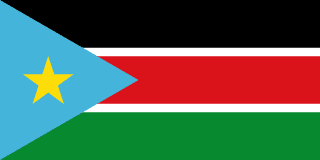
South Sudan is a landlocked country in East-Central Africa, bordered by Sudan to the north, Ethiopia to the east, Kenya, Uganda, and the Democratic Republic of the Congo to the south, and the Central African Republic to the west. It's the world's newest country, formed in 2011.
South Sudan's name straightforwardly reflects its position as the southern portion of what was formerly a unified Sudan, before achieving independence in 2011 following decades of civil conflict with the north.
Landscape: Includes vast wetlands around the Sudd, one of the largest swamps in the world, alongside savanna and rainforest further south.
Climate: Tropical, hot with a pronounced wet season.
Food: Ful medames, stewed fava beans, and kisra, a fermented flatbread, reflect South Sudan's shared culinary roots with Sudan.
Juba became South Sudan's capital upon its 2011 independence, having already served as a regional administrative centre under Sudanese rule. With a population of around 525,000, it remains the country's dominant political and commercial centre, though basic infrastructure remains limited given the country's recent formation and ongoing challenges.
The African fish eagle appears on South Sudan's coat of arms, and cattle hold deep cultural and economic significance across much of the country, central to traditional wealth, marriage customs, and social status among many South Sudanese communities.
Traditional South Sudanese cattle-camp culture, including intricate body scarification and decoration practices among some communities, reflects deeply rooted pastoral identity, and traditional beadwork and basket weaving remain practised across various ethnic groups. Traditional South Sudanese dance and singing, often tied closely to cattle-camp life, remain significant community expressions of identity and celebration.
The Sudd, one of the largest wetlands in the world, formed by the White Nile, dominates much of South Sudan's central geography and supports significant wildlife and traditional fishing and cattle-herding livelihoods.
South Sudan's Boma National Park is home to one of the largest wildlife migrations in the world, involving white-eared kob and other antelope species, a phenomenon only fully documented by researchers in the 2000s due to the country's long conflict.
South Sudan is majority Christian and traditional African religion, distinguishing it religiously from the majority Muslim north it separated from, and the country is home to numerous ethnic groups, including the Dinka and Nuer, both with deep cattle-herding cultural traditions.
South Sudan holds significant oil reserves, and crude oil exports form the overwhelming majority of the country's export revenue, though ongoing political instability has significantly affected production and trade infrastructure since independence.
Independence Day on July 9th marks 2011, when South Sudan became the world's newest country, separating from Sudan following decades of civil conflict. Martyrs' Day in July honours those who died during the long struggle for independence, and given the country's significant Christian and traditional African religious populations, Christmas is widely observed. South Sudan's SPLA Day in May honours the movement that led the long struggle for independence.
Basketball has grown significantly in South Sudanese sporting identity in recent years, the country having produced NBA players and fielded a surprisingly competitive Olympic basketball team relative to its status as one of the world's newest and least developed nations. Football also draws a significant domestic following.
South Sudan is a federal presidential republic, with a President serving as both head of state and government. The country has experienced significant internal conflict since gaining independence in 2011, including a civil war largely along ethnic lines that has severely affected its development and stability as one of the youngest nations in the world. South Sudan's oil reserves remain central to its economy, though ongoing conflict has significantly limited production and export capacity.
Kinyeti is South Sudan's highest point at 3,187 metres. The lowest point is along the White Nile, sitting around 381 metres above sea level, South Sudan's lowest point despite being well above true sea level, since the country is entirely landlocked. South Sudan's terrain is dominated by the vast Sudd wetland, one of the largest in the world.
Sudan, the country South Sudan separated from, uses an entirely different red-white-black horizontal Pan-Arab tricolour, meaning despite their shared name and history, the two countries' actual flags are genuinely distinct and not especially likely to be confused with each other. The black-red-green-blue combination with a gold star is unique among all African nations' flags.
Adopted in 2005 as part of the peace agreement ending decades of civil war with Sudan, kept unchanged when South Sudan became fully independent in 2011.
The world's newest country, gaining independence in 2011.
Play today's Flagpie →© Flagpie 2026