
Asia
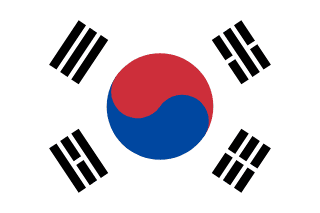
South Korea occupies the southern half of the Korean Peninsula in East Asia, bordered only by North Korea to the north, with coastlines on the Yellow Sea and the Sea of Japan.
Korea's name traces back to the Goryeo dynasty, which ruled from the 10th to 14th centuries and was itself named after an earlier kingdom, Goguryeo. 'South Korea' distinguishes the modern republic from North Korea, the two having split after the peninsula's division following the Second World War.
Landscape: Mostly mountainous and hilly, with around 70% of the country too rugged for farming, and a heavily developed coastal plain in the west.
Climate: Four distinct seasons, hot humid summers and cold, often snowy winters.
Food: Kimchi, fermented spiced vegetables, is served with nearly every meal, alongside Korean barbecue and bibimbap.
Seoul has served as Korea's capital since 1394, when the Joseon dynasty's founder chose the site partly for its favourable position along the Han River, and it has remained the political centre through the country's colonial period, division, and rapid modern development. Home to around 9.5 million people, and closer to 26 million across the wider metropolitan area, it grew from a walled royal capital into one of the most densely populated and technologically connected cities in the world.
The mugunghwa, a hibiscus flower, is South Korea's national flower, its Korean name roughly meaning 'eternity,' and it has been associated with Korean identity for centuries, long before its formal adoption after independence from Japan. The Korean magpie was designated the national bird in 1964, and the Siberian tiger, once native to the peninsula, remains a powerful cultural and historical symbol even though it no longer lives there in the wild.
The hanbok is Korea's traditional dress, characterised by its bright colours and simple, flowing lines, still worn for holidays, weddings, and formal occasions. Korean celadon pottery, prized for its distinctive jade-green glaze, was renowned across East Asia during the Goryeo dynasty and remains a respected craft tradition today.
Gyeongbokgung Palace, first built in 1395 as the main royal palace of the Joseon dynasty, remains one of Seoul's most visited landmarks, alongside the fortified city walls of Hwaseong and the historic villages of Andong and Gyeongju, capital of the ancient Silla kingdom.
The Asiatic black bear, recognisable by the pale crescent marking on its chest, survives in small numbers in South Korea's mountainous national parks after conservation reintroduction efforts. The red-crowned crane, shared culturally with Japan as a symbol of longevity, winters in the demilitarised zone between North and South Korea, one of the more unexpected wildlife refuges created by the peninsula's division.
South Korea has no dominant state religion, with the population split fairly evenly between Christianity, Buddhism, and those identifying with no religion at all, an unusually even three-way split for an East Asian country. Confucian values around family, education, and social hierarchy continue to shape everyday culture even among those who don't practise Confucianism as a religion specifically.
South Korea is a major global exporter of semiconductors, cars, and consumer electronics, home to globally recognised companies like Samsung and Hyundai, and has also become a significant exporter of cultural products, particularly K-pop music and Korean television and film.
Seollal, the Lunar New Year, is South Korea's most significant traditional holiday, marked by ancestral rites and family gatherings, typically falling in late January or February. Chuseok, a harvest festival held in autumn, is similarly centred on family and ancestral tradition, and Liberation Day on August 15th marks the end of Japanese colonial rule in 1945. Buddha's Birthday, celebrated with lantern festivals nationwide, reflects the country's significant Buddhist population alongside its large Christian one.
Taekwondo, a martial art developed in Korea, holds particular national significance as the country's signature sport, though football and baseball both draw considerably larger everyday audiences. South Korea has also become an unexpected global power in esports, with professional gaming treated with a level of mainstream respect and investment rarely matched elsewhere.
South Korea is a presidential republic, with a President serving a single five-year term as both head of state and head of government, unable to seek re-election, a deliberate constitutional safeguard against the kind of long-term authoritarian rule the country experienced for decades of the 20th century. The National Assembly serves as the country's single-chamber legislature. South Korea's rapid democratisation since the late 1980s, following decades of military rule, is often cited alongside its economic growth as one of the more remarkable national transformations of the 20th century.
Hallasan, a volcanic peak on the southern island of Jeju, is South Korea's highest point at 1,947 metres, its crater now home to a lake, and the mountain itself a UNESCO World Heritage Site. The lowest point sits at sea level along the country's coastline.
There's no other flag with the same red-and-blue taegeuk symbol at South Korea's centre, making the flag genuinely unmistakable. The four black trigrams in the corners are similarly unique, drawn from an ancient system of symbols not used decoratively by any other national flag, so despite the relatively simple white background, there's really nothing else in the world it could be confused with.
The core design dates to 1883, was suppressed during Japanese colonial rule in the early 20th century, and was formally readopted in 1948 when South Korea became an independent republic.
One of the most densely populated countries among the world's wealthiest economies.
Play today's Flagpie →© Flagpie 2026