
Asia
Singapore is a small island city-state at the southern tip of the Malay Peninsula in Southeast Asia, connected to Malaysia by a causeway.
Singapore's name comes from Sanskrit, roughly meaning 'lion city,' given by a Sumatran prince who, according to legend, spotted an animal he believed to be a lion on the island, though lions have never actually lived there.
Landscape: A small, low-lying island city-state, almost entirely urbanised with very little natural terrain remaining.
Climate: Tropical, hot and humid year-round with frequent rainfall and no distinct seasons.
Food: Chicken rice is widely considered a national dish, alongside laksa and a huge range of hawker-centre food reflecting Singapore's Malay, Chinese, and Indian heritage.
Singapore is itself a city-state, so the city and the country are effectively the same, growing rapidly from a British trading post established in 1819 into one of the world's busiest ports and financial centres. With a population of around 5.9 million across the whole country, its transformation from a relatively poor post-colonial territory to a wealthy global hub within a few decades is often cited as one of the more remarkable economic development stories of the 20th century.
The Merlion, a mythical creature with a lion's head and a fish's body, is Singapore's most recognised symbol, referencing both the country's name and its origins as a fishing village. Vanda Miss Joaquim, a hybrid orchid, is the national flower.
Singapore's craft traditions reflect its Chinese, Malay, and Indian heritage, from Peranakan beadwork and embroidery, tied to a distinct local Chinese-Malay culture, to traditional Malay silverwork and Indian textile arts, all still practised by specific communities today.
Gardens by the Bay, with its distinctive Supertree structures, and Marina Bay Sands, an integrated resort with a rooftop infinity pool, are both modern Singaporean landmarks, alongside the much older Sri Mariamman Temple, the country's oldest Hindu temple.
Despite its small size and dense urbanisation, Singapore retains significant biodiversity in reserves like Bukit Timah, home to more tree species than the entire continent of North America within a comparatively tiny protected area.
Singapore is religiously diverse, with significant Buddhist, Christian, Muslim, Hindu, and Taoist populations reflecting its Chinese, Malay, and Indian communities, each maintaining distinct cultural practices within a shared multicultural society.
Singapore is a major global trading and financial hub, exporting electronics, refined petroleum products, and machinery, with its port ranking among the busiest in the world by cargo volume.
National Day on August 9th marks 1965, when Singapore separated from Malaysia to become a fully independent nation, marked by an elaborate annual parade that's become one of the country's most significant civic events. Given Singapore's multicultural population, the country officially recognises major holidays across Chinese, Malay, Indian, and Western traditions, including Chinese New Year, Hari Raya, Deepavali, and Christmas all as public holidays.
Football holds the largest general domestic following in Singapore, though the country has achieved some of its most significant individual international success in swimming and table tennis relative to its small population. Formula One has also become a significant annual event since Singapore began hosting a night race in 2008, the sport's first ever. Sailing has also produced Singapore's most successful individual Olympic results relative to the country's small population.
Singapore is a parliamentary republic, with a largely ceremonial President as head of state and a Prime Minister holding real executive power, accountable to Parliament. The People's Action Party has governed continuously since Singapore's independence in 1965, presiding over the country's rapid transformation from a relatively poor post-colonial territory into one of the wealthiest nations in the world. Singapore's electoral system includes group representation constituencies, a distinctive feature designed to guarantee minority representation in parliament.
Bukit Timah Hill is Singapore's highest point at just 164 metres, reflecting the country's small, low-lying, and heavily urbanised geography. The lowest point sits at sea level around the island's coastline.
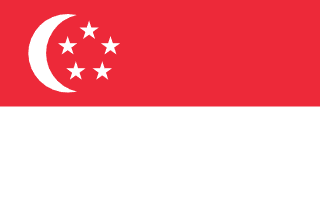
Poland uses the exact same red-and-white colours as Singapore, though as a simple two-stripe design without Singapore's crescent and stars, different enough in layout that direct confusion is unlikely. Indonesia's flag, also red and white, uses the colours in reverse order to Singapore's, similarly distinct enough given Singapore's additional symbols that the two aren't commonly mixed up despite the shared palette.
Adopted in 1959 while still a self-governing British colony, kept unchanged when Singapore became fully independent in 1965.
One of only three surviving city-states in the world.
Play today's Flagpie →© Flagpie 2026