
Africa
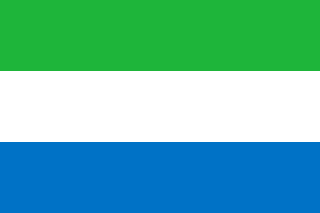
Sierra Leone sits on the Atlantic coast of West Africa, bordered by Guinea to the north and east and Liberia to the south.
Sierra Leone's name means 'lion mountains' in Portuguese, given by 15th-century Portuguese explorer Pedro de Sintra, reportedly inspired either by the mountainous coastal terrain's shape or the sound of thunder echoing like a lion's roar.
Landscape: Includes a coastal plain, one of the largest natural harbours in the world at Freetown, and mountains further inland.
Climate: Tropical, hot and humid with a pronounced wet season.
Food: Jollof rice and cassava leaves cooked with fish or meat are widely eaten staples.
Freetown was founded in 1792 by the Sierra Leone Company as a settlement for freed and formerly enslaved people, its name directly reflecting this founding purpose. With a population of around 1.2 million, it remains the country's dominant port and political centre, built around one of the largest natural harbours in the world.
The lion, referencing the country's namesake mountains, appears on Sierra Leone's coat of arms, and the country's diamond wealth, though a source of significant historical conflict, remains deeply tied to national economic identity.
Sierra Leonean gara tie-dye textile production, using indigo and other natural dyes in distinctive patterns, remains a significant living craft, and traditional Mende and Temne mask-making, tied to secret society ceremonies, reflects deep spiritual traditions. Traditional Sierra Leonean drumming and storytelling remain significant community practices, particularly within specific secret society ceremonial contexts.
The Tacugama Chimpanzee Sanctuary near Freetown reflects the country's ongoing conservation efforts, and the Bunce Island ruins, a former British slave trading post, serve as a significant site of historical memory regarding the transatlantic slave trade.
Sierra Leone's remaining Upper Guinean rainforest supports western chimpanzees and pygmy hippopotamuses, both facing significant conservation pressure from deforestation.
Sierra Leone is religiously mixed, with significant Muslim and Christian populations that have historically coexisted with notable tolerance, and the country's more recent history includes a brutal civil war through the 1990s and early 2000s, driven significantly by conflict over diamond resources.
Sierra Leone is a significant exporter of diamonds, titanium ore, and iron ore, with mining forming a substantial share of the national economy despite the historical challenges tied to so-called 'blood diamonds.'
Independence Day on April 27th marks 1961, when Sierra Leone gained sovereignty from British colonial rule. Given Sierra Leone's significant Muslim and Christian populations, both Eid holidays and Christmas are widely observed, reflecting the country's tradition of religious tolerance between the two faiths. Sierra Leone's Armed Forces Day in November honours the country's military. National Unity Day promotes reconciliation following the country's civil conflict. National Cleaning Day promotes community sanitation efforts nationwide.
Football holds the largest domestic following in Sierra Leone by a wide margin, even without major international competitive success to match, and athletics has also produced notable Sierra Leonean competitors at continental championships in recent years. Sierra Leonean athletics has produced regional competitors at continental championships. Sierra Leonean boxing has also produced notable competitors at continental level.
Sierra Leone is a presidential republic, with a President serving as both head of state and government. The country experienced a brutal civil war from 1991 to 2002, significantly fuelled by conflict over diamond resources, and Sierra Leone has since pursued reconciliation and reconstruction, including a notable Truth and Reconciliation Commission process. Sierra Leone's diamond and iron ore exports remain central to its economy despite past conflict tied to those resources.
Loma Mansa (Bintumani), in the Loma Mountains, is Sierra Leone's highest point at 1,948 metres. The lowest point sits at sea level along Sierra Leone's Atlantic coastline. Sierra Leone's terrain ranges from coastal mangrove swamps to forested highlands in the country's east.
There's no especially close match for Sierra Leone's flag, the green-white-blue horizontal stripes are a distinctive combination, deliberately avoiding both the red commonly used by neighbouring countries and the yellow-green-red Pan-African palette in favour of a design representing agriculture, peace, and the Atlantic Ocean respectively. The green-white-blue combination is a deliberately uncommon choice among West African nations' flags.
Adopted in 1961 upon independence, deliberately avoiding red, unlike many neighbouring countries, to represent a fresh start.
Home to one of the largest natural harbours in the world, at Freetown.
Play today's Flagpie →© Flagpie 2026