
Africa
Seychelles is an archipelago nation in the Indian Ocean, sitting northeast of Madagascar, off the eastern coast of Africa.
Seychelles is named after Jean Moreau de Séchelles, a French finance minister, honoured by French colonists who claimed the islands in the mid-18th century, with the name later anglicised to its current form.
Landscape: An archipelago of granite and coral islands in the Indian Ocean, among the oldest islands of their kind on Earth.
Climate: Tropical, warm year-round with minimal seasonal variation, sitting outside the main cyclone belt.
Food: Fish curries served with rice and a chilli-based condiment called satini are widely eaten staples.
Victoria, on the island of Mahé, has served as Seychelles's capital since British colonial times, named after Queen Victoria. With a population of around 26,000, it holds the distinction of being one of the smallest national capitals in the world by population.
The coco de mer, a palm tree producing the largest seed of any plant in the world and found naturally only in Seychelles, is the country's most distinctive national symbol, and the Seychelles black parrot is the national bird.
Seychellois Creole basket weaving using coconut palm fronds and traditional model boat building remain significant local crafts, and Seychellois moutya music and dance, with roots tracing back to enslaved communities, remains a genuinely significant living tradition. Traditional Seychellois storytelling, particularly featuring the folklore character Grann Kontrolez, remains passed down through generations in Creole oral tradition.
The Vallée de Mai on Praslin island, a UNESCO World Heritage Site sometimes called the original Garden of Eden in local folklore, protects a primeval forest of coco de mer palms found nowhere else on Earth. Anse Source d'Argent on La Digue, framed by distinctive granite boulders, is considered one of the most photographed beaches in the world.
Aldabra Atoll, a UNESCO World Heritage Site, is home to over 100,000 giant tortoises, the largest population of the species in the world, alongside significant seabird colonies relatively undisturbed by human presence.
Seychelles is majority Roman Catholic, and the country's Creole culture and language reflect a blend of French, African, and Asian heritage shaped by its history of colonisation and plantation-era immigration.
Seychelles's economy relies significantly on tourism, given its reputation as an exceptionally pristine and beautiful destination, alongside fishing and tuna canning.
Independence Day on June 29th marks 1976, when Seychelles gained sovereignty from British colonial rule. Given Seychelles's significant Catholic population, Christmas and Easter are both widely observed, and Liberation Day in June commemorates a 1977 coup that established the country's subsequent one-party socialist government before a later return to multi-party democracy. Seychelles's Creole Festival each October celebrates the island's distinct Creole language and culture. Seychelles's Constitution Day in June marks the country's founding legal document.
Football and athletics both hold significant followings in Seychelles, and sailing carries particular cultural significance given the country's status as a major Indian Ocean yachting and diving destination, closely tied to its broader tourism-based economy. Seychellois athletes have also competed in weightlifting and sailing at international level.
Seychelles is a presidential republic, with a President serving as both head of state and government, elected for a five-year term. The country transitioned from one-party socialist rule to multi-party democracy in the early 1990s, and Seychelles is widely regarded as one of Africa's wealthiest nations by GDP per capita, driven substantially by its high-end tourism industry. Seychelles is widely regarded as one of Africa's wealthiest nations by GDP per capita, driven by high-end tourism.
Morne Seychellois, on Mahé, is the country's highest point at 905 metres. The lowest point sits at sea level around the archipelago's granite and coral islands. Seychelles is unusual among tropical island nations for its granite, rather than purely volcanic or coral, geology.
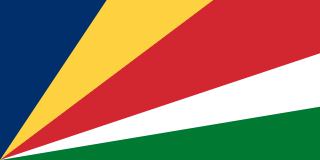
There's no especially close match for Seychelles's flag, the five diagonal bands of blue, yellow, red, white, and green radiating from the bottom-left corner make it one of very few national flags in the world to use a diagonal rather than horizontal, vertical, or triangular design structure. The diagonal ray design is one of the most structurally unusual among all current national flags.
Designed by Sacha Fabien.
Adopted in 1996, replacing an earlier post-independence flag, its diagonal band design deliberately unlike any other national flag at the time.
Made up of 115 islands, and home to the world's largest population of giant tortoises.
Play today's Flagpie →© Flagpie 2026