
Africa
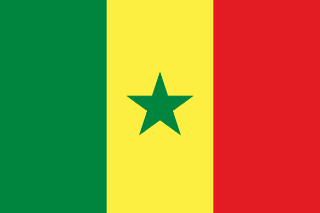
Senegal sits on the Atlantic coast of West Africa, bordered by Mauritania to the north, Mali to the east, and Guinea and Guinea-Bissau to the south, almost entirely surrounding the smaller country of the Gambia.
Senegal's name comes from the Senegal River, which forms part of the country's northern border, with the river's own name possibly derived from a Wolof phrase or an early Portuguese misinterpretation of a local place name.
Landscape: Mostly low, flat savanna, with the Sahel region in the north and more fertile land along the Senegal and Gambia Rivers.
Climate: Tropical, with a hot, dry season and a shorter, wetter monsoon season.
Food: Thiéboudienne, a fish and rice dish, is widely considered the national dish and among the most internationally recognised West African meals.
Dakar was founded by the French in 1857 and grew into a major colonial port city, becoming capital of independent Senegal in 1960. With a population of around 1.2 million in the city itself, it sits on the westernmost point of mainland Africa, historically a significant departure point during the transatlantic slave trade.
The lion is Senegal's national animal, giving the national football team its nickname, the Lions of Teranga, and the baobab tree holds deep cultural significance across the country's landscape and folklore.
Senegalese wax print textiles and traditional weaving remain significant crafts, and the country has a strong tradition of griot storytelling and music, an inherited oral history profession passed down within specific families for generations. Senegalese sabar drumming and dance, deeply tied to community celebration and storytelling, remain a vibrant and widely practised living tradition.
Gorée Island, a former centre of the transatlantic slave trade, is a UNESCO World Heritage Site and significant site of historical memory, and the Pink Lake (Lac Rose), which genuinely turns a striking pink colour due to algae, is one of Senegal's more unusual natural landmarks.
Niokolo-Koba National Park, though facing conservation challenges in recent decades, protects significant populations of West African wildlife including lions, elephants, and chimpanzees.
Senegal is overwhelmingly Muslim, and the country is notable for its Sufi Islamic brotherhoods, particularly the Mouride order, which hold significant social and economic influence, alongside a longstanding reputation for religious tolerance toward its Christian minority.
Senegal is a significant exporter of fish and seafood products, phosphates, and groundnuts, with fishing forming a particularly important part of both the economy and everyday coastal livelihoods.
Independence Day on April 4th marks 1960, when Senegal gained sovereignty from French colonial rule, celebrated nationwide with military parades and public festivities. Given Senegal's overwhelmingly Muslim population, Eid al-Fitr and Eid al-Adha are both major national holidays, alongside Christmas, reflecting the country's smaller but longstanding Christian minority and general tradition of religious tolerance. Magal of Touba, a major Sufi pilgrimage, draws millions of pilgrims annually to the holy city of Touba.
Traditional Senegalese wrestling (làmb), combining ritual and combat sport, is genuinely treated as the national sport, drawing crowds and prize money that rival football in national attention, a distinctly Senegalese sporting institution with roots stretching back centuries. Football is also hugely popular, the national team having reached the 2002 World Cup quarter-finals in just its second-ever tournament appearance. Senegalese athletics has also produced notable competitors at continental championships in recent years.
Senegal is a presidential republic, with a President serving as both head of state and government, elected for a five-year term. The country is widely regarded as one of West Africa's most stable democracies, having never experienced a successful military coup since independence, a notable distinction in the wider region. Senegal's peaceful democratic transitions have made it a frequently cited example of stability within the wider West African region.
Senegal's highest point sits at around 648 metres near the border with Guinea, in the country's southeastern highlands. The lowest point sits at sea level along Senegal's Atlantic coastline. Senegal's flat, mostly low-lying terrain contrasts with its southeastern highlands near the Guinea border.
Mali's flag uses the exact same green-yellow-red vertical tricolour as Senegal's, the two countries having briefly formed a short-lived federation together in 1959 before splitting, and Senegal's own small green star at the centre is what most clearly distinguishes it from Mali's plain, unadorned version of the same three stripes.
Adopted in 1960 at independence, originally featuring a black star before it was replaced with a simpler green star still on the flag today.
Home to Lake Retba, also known as 'Lac Rose,' a lake famous for turning bubblegum pink.
Play today's Flagpie →© Flagpie 2026