
Asia
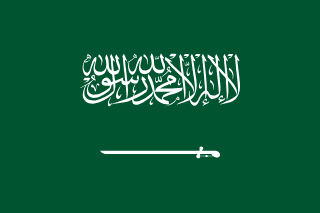
Saudi Arabia occupies most of the Arabian Peninsula, bordered by Jordan and Iraq to the north, Kuwait, Qatar, and the United Arab Emirates to the east, Oman to the southeast, and Yemen to the south.
This flag has the highest proportion of green of any flag in Flagpie, at 95%.
Saudi Arabia's name comes directly from the House of Saud, the ruling royal family, combined with 'Arabia,' referring to the Arabian Peninsula, making it one of relatively few countries named directly after its ruling dynasty.
Landscape: Mostly desert, including the Rub' al Khali (Empty Quarter), one of the largest continuous sand deserts in the world, with mountains along the western Red Sea coast.
Climate: Extremely arid and hot through most of the year, with cooler conditions at higher elevations.
Food: Kabsa, a spiced rice dish usually served with chicken or lamb, is considered the national dish.
Riyadh grew from a walled desert settlement into Saudi Arabia's capital as the House of Saud consolidated control over the peninsula in the early 20th century. With a population of around 7.6 million, it has transformed rapidly in recent decades from a relatively modest desert city into a major modern metropolis as part of the country's broader economic diversification push.
The Arabian oryx, a striking white antelope once extinct in the wild and successfully reintroduced through captive breeding, is closely associated with Saudi Arabia and the wider Arabian Peninsula. The date palm appears on the national emblem alongside two crossed swords.
Bedouin weaving and silverwork carry deep roots in Saudi Arabia's nomadic desert heritage, and traditional dress, the thobe for men and abaya for women, remains widely worn as everyday clothing rather than purely ceremonial dress.
Mecca, Islam's holiest city, and Medina are both located in Saudi Arabia and receive millions of Muslim pilgrims each year for Hajj and Umrah. Al-Ula, home to ancient Nabataean rock-cut tombs similar to those at Petra in Jordan, is a more recently opened archaeological site.
The Arabian oryx and Arabian leopard, both once critically endangered, are the focus of significant conservation efforts within Saudi Arabia's desert reserves.
Saudi Arabia is the birthplace of Islam and home to its two holiest cities, and the country is governed according to Islamic law, with the overwhelming majority of citizens practising Sunni Islam.
Saudi Arabia is one of the world's largest exporters of crude oil, historically forming the backbone of its economy, though the government has been actively working to diversify into tourism, technology, and other sectors in recent years.
Saudi National Day on September 23rd marks the 1932 unification of the country's regions under King Abdulaziz, celebrated increasingly openly and publicly in recent years as part of the country's broader social changes. Eid al-Fitr and Eid al-Adha are both major nationwide holidays, and the annual Hajj pilgrimage to Mecca, drawing millions of Muslims from around the world each year, represents one of the largest religious gatherings on Earth.
Football has become an increasingly significant focus of national investment and pride in Saudi Arabia in recent years, with major international players joining the domestic league as part of a deliberate push to raise the sport's profile. Camel racing remains a genuinely significant traditional sport too, reflecting the country's deep Bedouin desert heritage, alongside falconry, which carries similar cultural weight.
Saudi Arabia is an absolute monarchy, with the King holding both political and religious authority as Custodian of the Two Holy Mosques, a title referring to Mecca and Medina. The country has no elected national legislature, governing instead through royal decree alongside an appointed Consultative Assembly, though it has undergone significant social and economic reform in recent years under its current leadership.
Jabal Sawda, in the country's southwest, is Saudi Arabia's highest point at around 3,015 metres, considerably cooler and greener than the desert most associate with the country. The lowest point sits at sea level along Saudi Arabia's coastlines on both the Red Sea and the Persian Gulf.
There's no close match for Saudi Arabia's flag, the green field with white Arabic script and a sword beneath it is distinctive enough globally that confusion is essentially impossible, and it holds the notable distinction of being one of the only national flags in the world that's never flown at half-mast, since it carries the Islamic declaration of faith, considered inappropriate to lower.
The current design dates to 1973, carrying the Islamic declaration of faith in Arabic script above a sword, a design element used in various forms since the early 20th century.
The largest country in the world with no permanent rivers or lakes at all.
Play today's Flagpie →© Flagpie 2026