
Africa
São Tomé and Príncipe is a small island nation in the Gulf of Guinea, off the western coast of Central Africa, made up of two main islands.
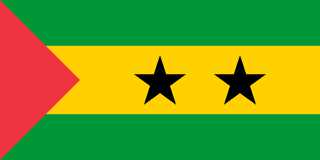
This flag has the highest proportion of light green of any flag in Flagpie, at 53%.
São Tomé and Príncipe's name comes from Saint Thomas and Prince Anthony, with the main island named by Portuguese explorers who arrived on Saint Thomas's feast day, and the smaller island named in honour of Portugal's Prince Anthony.
Landscape: Two small volcanic islands in the Gulf of Guinea, mountainous and densely forested.
Climate: Tropical, warm and humid year-round with a wet and dry season.
Food: Calulu, a fish or meat stew with leafy greens and okra, is widely considered the national dish.
São Tomé has served as the country's capital since Portuguese colonial times, growing from an early colonial trading post into the country's political and economic centre. With a population of around 80,000, it remains a relatively small but significant regional port town for the two-island nation.
The grey parrot, though facing significant population pressure from the pet trade regionally, is closely tied to the islands' identity, and cocoa, historically central to the colonial-era economy, remains deeply significant to national identity.
Santomean traditional dance forms, including the Danço Congo, a theatrical performance blending African and Portuguese influences, reflect the islands' unique Creole cultural heritage, and traditional wood carving remains practised in rural communities. Traditional palm wine tapping remains a genuinely everyday rural practice across both islands.
Pico Cão Grande, a dramatic volcanic spire rising nearly 370 metres from the rainforest, is one of the country's most striking natural landmarks, alongside the well-preserved colonial architecture of São Tomé's old town.
The islands' isolation has produced significant endemic biodiversity, including numerous bird species found nowhere else, reflecting the archipelago's status as a globally significant biodiversity hotspot despite its tiny size.
São Tomé and Príncipe is majority Roman Catholic, reflecting Portuguese colonial history, and the islands' Forro Creole culture and language developed among descendants of enslaved Africans brought to work the colonial-era plantations. The islands' small, close-knit population and relatively recent independence in 1975 have shaped a distinct national identity built significantly around the shared plantation-era history.
São Tomé and Príncipe is historically known for high-quality cocoa production, once one of the world's largest producers, alongside more recent efforts to develop coffee and specialty agricultural exports.
Independence Day on July 12th marks 1975, when São Tomé and Príncipe gained sovereignty from Portugal. Given the country's significant Catholic population, Christmas and Easter are both widely observed, and Freedom Day in June commemorates a significant 1953 uprising against forced colonial labour practices. Discovery Day in January marks the Portuguese arrival on the previously uninhabited islands. Agostinho Neto Day honours ties with fellow former Portuguese colony Angola.
Football holds the largest domestic following in São Tomé and Príncipe, even without major international competitive success to match, and traditional dance forms, including the Danço Congo, carry cultural significance that extends well beyond conventional sport in national life. The country has also competed in athletics at recent Olympic Games. The country has also fielded competitors in judo at recent Games.
São Tomé and Príncipe is a semi-presidential republic, splitting executive authority between a directly elected President and a Prime Minister accountable to a single-chamber National Assembly. The country is widely regarded as one of Africa's more stable democracies, having maintained continuous multi-party elections since adopting the system in 1990. São Tomé and Príncipe's economy relies significantly on cocoa exports and growing offshore oil exploration interest.
Pico de São Tomé is the country's highest point at 2,024 metres. The lowest point sits at sea level around the two main islands' coastlines. The islands' volcanic terrain supports rich biodiversity within a relatively small total land area.
Ghana, Senegal, Guinea, and numerous other African nations all use variations of São Tomé and Príncipe's green-yellow-black colour combination, part of the broader Pan-African tradition, and the country's own two stars, representing its two main islands, are what most clearly distinguish it from its regional cousins' differently arranged versions of similar palettes. The two-star design directly reflects the country's exact two main islands, unlike many other star-based flags.
Adopted in 1975 upon independence from Portugal, following the same Pan-African colour tradition used by Ghana and several other former colonies.
The second-smallest country in Africa, and one of the least visited countries on Earth.
Play today's Flagpie →© Flagpie 2026