
Oceania
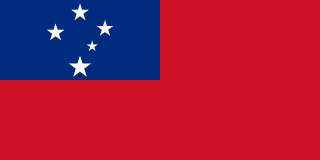
Samoa is a Polynesian island nation in the South Pacific, sitting northeast of Fiji and just west of American Samoa.
Samoa's name origin is debated within Samoan oral tradition itself, with various accounts linking it to a legendary figure or a phrase describing the centre of the sacred Polynesian world, reflecting the islands' deep significance in wider Polynesian cultural history.
Landscape: Two main volcanic islands with mountainous, rainforest-covered interiors and coastal plains where most villages sit.
Climate: Tropical, warm and humid year-round with a wet season.
Food: Palusami, taro leaves baked with coconut cream, is widely considered a national dish.
Apia became Samoa's capital in the 19th century, growing from a small trading settlement into the country's dominant political and commercial centre. With a population of around 40,000, it was also the final home of Scottish author Robert Louis Stevenson, whose estate remains a significant local landmark.
The manumea, a distinctive tooth-billed pigeon found only in Samoa and considered the closest living relative to the extinct dodo, is the national bird, and traditional Samoan fa'a Samoa (the Samoan way of life) itself functions as a powerful unofficial national symbol.
Samoan siapo (bark cloth) making, using the inner bark of the paper mulberry tree stamped with traditional patterns, and traditional Samoan tattooing (tatau), performed using ancient hand-tapping techniques, remain significant and actively practised living traditions. The traditional Samoan kava ceremony, involving formal seating and speech-making protocol, remains a genuinely significant part of important community gatherings.
The To Sua Ocean Trench, a giant swimming hole connected to the ocean by an underground channel, is one of Samoa's most photographed natural landmarks, and Robert Louis Stevenson's former estate at Vailima remains a significant cultural site.
The manumea, Samoa's endangered national bird, survives only in the country's remaining native forest, and Samoa's rainforest supports flying foxes and numerous bird species found across limited parts of the wider Pacific.
Samoa is overwhelmingly Christian, and the country's fa'a Samoa social system, including the matai chieftain structure and communal land ownership, remains genuinely central to how Samoan society and governance actually function today.
Samoa's economy relies significantly on tourism and remittances from Samoans living abroad, alongside modest exports of coconut products and fish.
Independence Day on June 1st marks 1962, when Samoa became the first Pacific island nation to gain sovereignty in the modern era, having previously been administered by New Zealand. White Sunday in October is a distinctly Samoan celebration honouring children, who are treated as guests of honour at church and family gatherings for the day. Samoa's Teuila Festival each September showcases traditional dance, music, and floral arrangements.
Rugby union holds a place in Samoan national identity matched by few other sports, the small nation having produced a remarkable number of players who've gone on to represent other countries, particularly New Zealand and Australia, at the international level. Rugby league and boxing have also produced notable Samoan competitors. Samoan boxing has also produced notable competitors at the Commonwealth Games.
Samoa is a parliamentary republic, with a largely ceremonial head of state (O le Ao o le Malo) and a Prime Minister holding real executive power, accountable to a single-chamber Legislative Assembly. The country's fa'a Samoa (Samoan way of life), including the matai chieftain system and communal land ownership, remains genuinely central to how Samoan society and governance actually function. Samoa's economy relies significantly on remittances from Samoans living abroad, particularly in New Zealand and the United States.
Mauga Silisili, on Savai'i, is Samoa's highest point at 1,858 metres. The lowest point sits at sea level around the country's islands. Samoa's volcanic terrain across its two main islands supports dense tropical rainforest cover.
New Zealand's flag shares Samoa's use of the Southern Cross constellation, both former administrative ties to New Zealand reflected in the shared symbolism, though Samoa's flag carries the stars alongside the Union Jack in a different arrangement, distinctive enough not to be easily confused with New Zealand's own design. The specific star arrangement differs enough from other Pacific flags using the Southern Cross to remain distinguishable.
Adopted in 1949 while still administered by New Zealand, kept unchanged when Samoa gained full independence in 1962.
Administered by New Zealand from 1920 until becoming the first Pacific island nation to gain independence, in 1962.
Play today's Flagpie →© Flagpie 2026