
North America
Saint Lucia is an island country in the Caribbean's Windward Islands, sitting between Martinique to the north and Saint Vincent and the Grenadines to the south. It's one of the few countries in the world named after a woman, Saint Lucy of Syracuse.
Saint Lucia is named after Saint Lucy of Syracuse, reportedly because French sailors were shipwrecked there on her feast day, making it one of relatively few countries in the world named after a woman.
Landscape: A volcanic island dominated by the Pitons, two dramatic mountain peaks rising directly from the sea, with rainforest across the interior.
Climate: Tropical, warm year-round with a wet season and hurricane risk.
Food: Green fig and saltfish, made with unripe bananas, is the national dish.
Castries has served as Saint Lucia's capital since French colonial times, its natural harbour making it a valuable strategic port fought over repeatedly by the French and British, with control of the island changing hands more times than almost any other Caribbean territory. With a population of around 20,000, it remains the country's main commercial centre.
The Saint Lucia parrot, found only on the island and once critically endangered, is the national bird, and has become a significant symbol of the country's conservation success after a dedicated recovery programme brought it back from the brink.
Saint Lucian pottery and traditional Creole dress, featuring the madras plaid fabric brought by French colonists, remain significant cultural traditions, particularly displayed during the island's annual Jounen Kwéyòl (Creole Day) celebrations. Saint Lucian basket weaving using local latanye palm leaves remains a distinctive and actively taught craft passed down through generations.
The Pitons, two dramatic volcanic peaks rising directly from the sea, are Saint Lucia's most iconic landmark and a UNESCO World Heritage Site, alongside Sulphur Springs, often promoted as the world's only drive-in volcano.
The Saint Lucia parrot's recovery from fewer than 100 birds in the 1970s to a healthier population today stands as one of the Caribbean's clearest conservation success stories.
Saint Lucia is majority Roman Catholic, reflecting French colonial influence, and the island's Creole language and culture, blending French and West African heritage, remain a genuinely significant part of everyday life alongside English, the official language.
Saint Lucia's economy relies significantly on tourism given its dramatic scenery, alongside modest banana exports, historically the backbone of the island's agricultural economy.
Independence Day on February 22nd marks 1979, when Saint Lucia gained sovereignty from British colonial rule. Jounen Kwéyòl (Creole Day) in October celebrates the island's French Creole heritage with traditional dress, food, and music, and Saint Lucia's patron saint feast day reflects the island's significant Catholic population. Saint Lucia's National Day celebrations stretch across a full month of cultural festivities each December. Saint Lucia's Discovery Day marks Columbus's reported sighting of the island.
Cricket and football both hold significant followings in Saint Lucia, and athletics has produced the country's most significant individual international recognition, Saint Lucia having won its first ever Olympic medal, a gold, in the women's 100 metres at the 2024 Games, a landmark achievement for the small island nation. Saint Lucian netball has also grown in domestic popularity among young women. Saint Lucian football has grown steadily through regional Caribbean competition.
Saint Lucia is a parliamentary constitutional monarchy, with the British monarch as ceremonial head of state represented domestically by a Governor-General, while a Prime Minister holds real executive power accountable to a bicameral parliament. The island changed hands between French and British colonial rule more times than almost any other Caribbean territory, a history still reflected in its blended Creole culture today. Saint Lucia's economy relies significantly on tourism and, historically, banana exports.
Mount Gimie is Saint Lucia's highest point at 950 metres. The lowest point sits at sea level around the island's coastline, including near its iconic twin Piton peaks. Saint Lucia's dramatic Piton peaks rise directly from the sea along its southwestern coast.
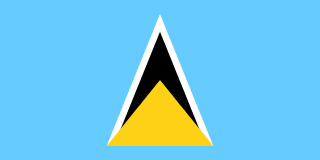
There's no especially close match for Saint Lucia's flag, the blue field with a black-and-white triangular design representing the island's twin Piton peaks is a distinctive combination, that specific geographic reference unique to Saint Lucia's own landscape. The Piton-inspired triangle design is unique among all Caribbean nations' flags.
Designed by Dunstan St Omer.
Adopted in 1967, with the shade of blue adjusted slightly in 2002 to more accurately reflect the colour of the Caribbean Sea.
One of the only countries in the world named after a woman, Saint Lucy of Syracuse.
Play today's Flagpie →© Flagpie 2026