
Africa
Rwanda is a small, landlocked country in East Africa, bordered by Uganda to the north, Tanzania to the east, Burundi to the south, and the Democratic Republic of the Congo to the west.
Rwanda's name comes from the Kinyarwanda language, referring to the historic kingdom that once controlled the region, with the name's precise original meaning debated but tied closely to the country's pre-colonial monarchy.
Landscape: Hilly and mountainous, often called the 'Land of a Thousand Hills,' with volcanic mountains in the northwest home to endangered mountain gorillas.
Climate: Temperate highland, moderated significantly by elevation despite its equatorial location.
Food: Ugali and beans form the everyday staple diet, often served with a vegetable stew.
Kigali has served as Rwanda's capital since independence in 1962, and has undergone a remarkable transformation in the decades since the 1994 genocide, becoming known internationally for its cleanliness, safety, and rapid development. With a population of around 1.2 million, it's often cited as a notable example of post-conflict urban recovery.
The Intore dancers, traditional Rwandan warrior dancers known for elaborate headdresses and dramatic performances, represent a significant living national cultural symbol, and the crested crane, shared symbolically with Uganda, is closely tied to regional identity.
Rwandan Agaseke peace baskets, tightly woven baskets historically given as gifts of friendship and reconciliation, have become internationally significant both as craft objects and as symbols of the country's post-genocide healing process. Traditional Rwandan Intore dance performances, involving elaborate grass headdresses, remain widely performed at both cultural festivals and official state occasions.
Volcanoes National Park, home to a significant share of the world's remaining mountain gorillas, is Rwanda's most internationally significant landmark, alongside genocide memorial sites that serve as places of national remembrance and education.
Volcanoes National Park protects mountain gorillas made famous internationally through the work of primatologist Dian Fossey, and Rwanda has become a significant conservation success story for the species in recent decades.
Rwanda is majority Christian, predominantly Roman Catholic, and the country's more recent history includes the 1994 genocide against the Tutsi, an event that remains central to national memory, reconciliation efforts, and ongoing social policy. Rwanda has one of the highest proportions of women in national parliament of any country in the world, a deliberate outcome of post-genocide constitutional reform.
Rwanda is a significant exporter of coffee and tea, alongside minerals including tin and tantalum, with the country's economy having grown significantly in the decades following the 1994 genocide.
Independence Day on July 1st marks 1962, when Rwanda gained sovereignty from Belgian administration. Liberation Day on July 4th marks 1994, when the genocide against the Tutsi ended, a date of profound significance given the scale of that tragedy, and Kwibuka, a period of remembrance beginning in April each year, is dedicated specifically to honouring genocide victims. Rwanda's Umuganda, a monthly nationwide community service day, remains a genuinely observed civic tradition.
Football and cycling both hold significant places in Rwandan sporting culture, the Tour du Rwanda having grown into one of Africa's most significant cycling races and reflecting the country's notably hilly terrain, earning Rwanda the nickname 'Land of a Thousand Hills.' Basketball has also grown considerably, with Rwanda hosting a significant NBA-affiliated African league.
Rwanda is a presidential republic, with a President serving as both head of state and government. The country's modern political system was significantly shaped by the 1994 genocide against the Tutsi, and Rwanda has since pursued a deliberate policy of ethnic reconciliation alongside rapid economic development, becoming known internationally for its cleanliness, low crime, and relatively centralised governance. Rwanda has one of the highest proportions of women in national parliament of any country in the world.
Mount Karisimbi, a dormant volcano shared with the Democratic Republic of the Congo, is Rwanda's highest point at 4,507 metres. Lake Rukwa's associated valley area holds the lowest point at around 950 metres above sea level, Rwanda's lowest point despite being well above true sea level, since the country is entirely landlocked. Rwanda's hilly terrain, giving it the nickname 'land of a thousand hills,' shapes much of its agricultural land use.
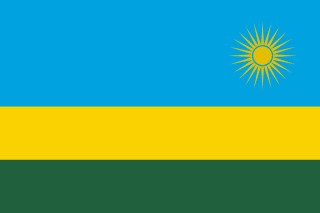
There's no especially close match for Rwanda's flag, the blue-yellow-green horizontal bands topped by a golden sun with 24 rays are a distinctive combination, adopted in 2001 specifically to replace the country's earlier post-genocide flag, which had become too closely associated with that painful period.
Adopted in 2001, replacing the country's post-genocide flag entirely, a deliberate break from a design too closely associated with the 1994 genocide.
One of the most densely populated countries in Africa, and home to roughly half of the world's remaining mountain gorillas.
Play today's Flagpie →© Flagpie 2026