
Asia
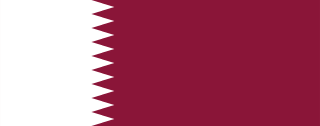
Qatar occupies a small peninsula jutting into the Persian Gulf from Saudi Arabia, its only land neighbour.
Qatar's name origin is uncertain, though it has appeared in various forms in historical texts referring to the peninsula for close to two thousand years, likely derived from an older regional or tribal name.
Landscape: A flat, low-lying peninsula extending into the Persian Gulf, almost entirely desert.
Climate: Desert climate, extremely hot and humid summers, mild winters.
Food: Machbous, a spiced rice and meat dish, is widely considered Qatar's national dish.
Doha grew from a small pearl-diving and fishing settlement into Qatar's capital, expanding rapidly following the discovery of oil and gas in the mid-20th century. With a population of around 1.2 million, it has transformed dramatically in recent decades, hosting the 2022 FIFA World Cup as part of a broader push to raise its international profile.
The Arabian oryx is Qatar's national animal, shared symbolically with several neighbouring Gulf states, and the falcon holds similar cultural significance in Qatar as elsewhere in the region, tied to Bedouin falconry traditions.
Qatar has traditions in pearl diving, historically one of the region's main industries before the discovery of oil, alongside Bedouin weaving and traditional dhow boat building, still practised by some craftsmen today. Modern Qatari fashion and jewellery design has also grown significantly in recent years, blending traditional Gulf aesthetics with contemporary luxury design.
The Museum of Islamic Art in Doha, designed by architect I. M. Pei, houses one of the most significant collections of Islamic art in the world, and Souq Waqif, a restored traditional market, reflects Doha's pre-oil trading history. Katara Cultural Village, a purpose-built arts and heritage district in Doha, was developed specifically to showcase Qatari and broader Arab cultural traditions to both residents and visitors.
Qatar's desert and coastal environments support the Arabian oryx in protected reserves, alongside significant populations of migratory birds along its coastline.
Qatar is majority Muslim, and Islam is the official state religion, with a very large foreign resident population, similar to the UAE, making up the overwhelming majority of people actually living in the country day to day.
Qatar is one of the world's largest exporters of liquefied natural gas, which forms the overwhelming majority of the country's export revenue and has made it one of the wealthiest countries in the world by income per capita.
Qatar National Day on December 18th marks 1878, when Sheikh Jassim bin Mohammed Al Thani took power and began unifying the country's tribes, treated as the founding moment of the modern Qatari state. Eid al-Fitr and Eid al-Adha are both major national holidays, and National Sport Day, held annually in February, is a distinctly Qatari public holiday specifically dedicated to encouraging physical activity nationwide. Qatar's National Sport Day, unusually, closes schools, universities, and many workplaces specifically to encourage nationwide physical activity for a single day each year.
Football has become an enormous national focus in Qatar in recent decades, culminating in the country hosting the 2022 FIFA World Cup, the first Middle Eastern nation to do so. Falconry and camel racing both remain genuinely significant traditional pursuits reflecting Qatar's Bedouin heritage, and the country has invested heavily in becoming a major host for international sporting events well beyond football.
Qatar is an absolute monarchy, with the Emir holding supreme executive, legislative, and judicial authority, advised by an appointed Shura Council. The country has no political parties and limited elected representation, governing instead through a hereditary system centred on the Al Thani family, which has ruled Qatar since the 19th century.
Qurayn Abu al Bawl, in the country's south, is Qatar's highest point at just 103 metres, reflecting the country's almost entirely flat, low desert terrain. The lowest point is a depression called Sabkhat Nu'ayjah, sitting slightly below sea level in the south of the country.
Bahrain's flag is Qatar's closest match by a wide margin, both use the same maroon-and-white serrated design, differing mainly in shade, Qatar's is a deeper maroon, and in the number of serration points, Qatar uses nine, Bahrain uses five, a distinction specifically adopted to tell the two apart after both countries once used more similar designs.
Adopted in 1971, the maroon shade and distinctive nine-point serrated edge were formalised over the following decades, distinguishing it from Bahrain's similar design.
Has one of the most unusual flag shapes in the world, roughly three times as wide as it is tall.
Play today's Flagpie →© Flagpie 2026