
Europe
Poland sits on the North European Plain, bordered by Germany to the west, Czechia and Slovakia to the south, Ukraine and Belarus to the east, and Lithuania and Russia's Kaliningrad to the northeast, with a coastline on the Baltic Sea.
Poland's name comes from the Polans, an early Slavic tribe whose name meant roughly 'people of the open fields,' referring to the flat farmland of the region where they settled and eventually formed the core of the Polish state.
Landscape: Mostly flat lowland plains, with the Carpathian and Sudetes mountains along the southern border and a Baltic Sea coastline in the north.
Climate: Temperate, with warm summers and cold, often snowy winters.
Food: Pierogi (filled dumplings) and kielbasa (sausage) are Poland's best known dishes, alongside bigos, a hunter's stew.
Warsaw became Poland's capital in 1596, replacing Kraków, chosen partly for its more central location within the growing Polish-Lithuanian Commonwealth. Nearly destroyed during the Second World War, with much of its historic centre deliberately levelled, it was painstakingly rebuilt afterward based on old paintings and photographs, and its Old Town is now a UNESCO World Heritage Site specifically because of that reconstruction effort.
The white-tailed eagle, depicted on a red shield, is Poland's national emblem, with roots in Polish heraldry going back to the medieval period. The European bison, or wisent, survives in the wild in Poland's Białowieża Forest, one of the last remaining fragments of the primeval forest that once covered much of the continent.
Polish pottery from Bolesławiec, known for its distinctive blue and white stamped patterns, has built a strong international following, alongside a long tradition of amber jewellery, since Poland's Baltic coast is one of the world's richest sources of amber.
Wawel Castle in Kraków, seat of Polish kings for centuries, remains one of the country's most significant historic sites, alongside the Auschwitz-Birkenau memorial, preserved as a site of remembrance for victims of the Holocaust.
The European bison, Europe's heaviest land animal, was hunted to extinction in the wild in the early 20th century and has since been successfully reintroduced to Białowieża Forest through a captive breeding programme that saved the species. Poland's forests and wetlands also support wolves, lynx, and significant populations of storks.
Poland is one of Europe's most strongly Roman Catholic countries, with the Church playing a significant role in both the country's identity and its 20th-century resistance to Soviet-aligned rule under figures like Pope John Paul II.
Poland is a significant exporter of machinery, cars and automotive parts, and furniture, and has become an increasingly important manufacturing base within the European Union in recent decades.
Independence Day on November 11th marks 1918, when Poland re-emerged as a sovereign nation after over a century of partition between neighbouring empires, a date of profound significance given how long statehood had been suspended. Constitution Day on May 3rd marks the 1791 adoption of Europe's first modern written constitution, and All Saints' Day on November 1st is marked nationwide by visiting and lighting candles at family graves. Śmigus-Dyngus on Easter Monday involves the good-natured tradition of dousing others with water, a custom with roots predating Christianity's arrival in the region.
Football and volleyball both hold major followings in Poland, the men's volleyball team having become one of the most successful international programmes in the sport in recent decades. Poland has also produced a number of world-class ski jumpers, a sport that draws particularly passionate domestic support. Poland has also produced a strong tradition in track cycling and, more recently, competitive esports.
Poland is a parliamentary republic, with a directly elected President serving alongside a Prime Minister who holds most day-to-day executive power, accountable to a bicameral parliament. The country's modern democratic system was established in 1989 following the fall of communism, and Poland has since become one of the more prominent members of both the European Union and NATO in Central Europe.
Rysy, in the Tatra Mountains on the border with Slovakia, is Poland's highest point at 2,499 metres. The lowest point is a reclaimed delta area near Raczki Elbląskie in the north, sitting around 2 metres below sea level.
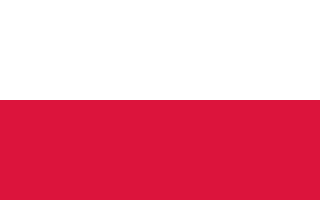
Indonesia and Monaco both use the exact same two colours as Poland, red and white, but with the order reversed, red on top rather than Poland's white, making all three flags part of a small, genuinely easily confused family distinguished only by which colour sits on top. Beyond that specific pair, no other flag comes close to matching Poland's simple two-stripe design.
White and red were formally adopted in 1919 after Poland regained independence, drawn from the colours of the Polish coat of arms, which had been in use for centuries prior.
Was part of the powerful Polish-Lithuanian Commonwealth, once one of the largest and most populous countries in Europe.
Play today's Flagpie →© Flagpie 2026