
Asia
The Philippines is an archipelago nation in Southeast Asia, sitting in the western Pacific Ocean between the South China Sea and the Philippine Sea, south of Taiwan.
The Philippines is named after King Philip II of Spain, bestowed by Spanish explorer Ruy López de Villalobos in 1543, decades before the islands were actually fully colonised by Spain.
Landscape: An archipelago of over 7,600 islands, mountainous and volcanic, with extensive coastline and coral reefs.
Climate: Tropical, hot and humid year-round, with a distinct typhoon season.
Food: Adobo, meat marinated and simmered in vinegar and soy sauce, is widely considered the national dish, alongside lechon, whole roasted pig.
Manila has served as the Philippines' capital since Spanish colonisation began in 1571, built on the site of an earlier Muslim settlement at the mouth of the Pasig River. With a population of around 1.8 million in the city itself, and well over 13 million across greater Manila, it grew from a Spanish colonial trading post into the country's political and economic centre.
The Philippine eagle, one of the largest and rarest eagles in the world, found only in the country's remaining forests, is the national bird and a powerful symbol of conservation urgency. Sampaguita, a fragrant white jasmine, is the national flower, often strung into garlands for guests and religious offerings.
The barong tagalog, a lightweight embroidered formal shirt, is the Philippines' traditional national dress for men, alongside the baro't saya for women. Filipino weaving traditions, including intricate handwoven textiles from Indigenous groups like the T'boli, remain actively practised in various regions.
The Banaue Rice Terraces, carved into mountainsides over 2,000 years ago by Indigenous communities without modern tools, are often called the 'eighth wonder of the world' and remain in active use today. The historic walled city of Intramuros in Manila reflects the country's Spanish colonial period.
The Philippine eagle, tarsier (one of the smallest primates in the world), and Philippine tamaraw, a small wild buffalo found only on the island of Mindoro, are all found nowhere else on Earth, reflecting the country's status as one of the world's biodiversity hotspots.
The Philippines is the only majority Roman Catholic country in Asia, a direct legacy of over 300 years of Spanish colonial rule, alongside a significant Muslim population concentrated in the southern island of Mindanao.
The Philippines is a major exporter of electronics and semiconductors, alongside coconut products, of which it's one of the world's largest producers, and a significant share of its economy relies on remittances sent home by Filipino workers abroad.
Independence Day on June 12th marks 1898, when the Philippines declared independence from Spanish colonial rule, though full sovereignty wasn't achieved until decades later following a period of American administration. Christmas is celebrated with particular enthusiasm and length in the Philippines, with festivities often beginning as early as September, giving the country one of the longest Christmas seasons in the world. Sinulog in Cebu each January, honouring the Santo Niño, draws one of the largest religious street festival crowds in the country.
Basketball holds an outsized place in Philippine sporting culture relative to almost anywhere else in Asia, played and watched with genuine national obsession despite the country's comparatively modest international results in the sport. Arnis, a traditional Filipino martial art using sticks and blades, was officially declared the national sport and martial art in 2009, and boxing has produced some of the country's most celebrated modern sporting heroes.
The Philippines is a presidential republic, with a President serving as both head of state and government, elected for a single six-year term with no possibility of re-election. The country's political system was modelled significantly on that of the United States following decades of American colonial administration in the early 20th century, and it operates a bicameral Congress.
Mount Apo, on the island of Mindanao, is the Philippines's highest point at 2,954 metres, an active volcano and home to significant biodiversity including the critically endangered Philippine eagle. The lowest point sits at sea level across the country's more than 7,600 islands.
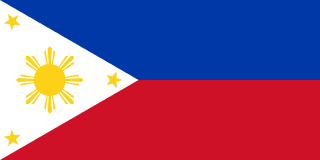
Cuba's flag shares a broadly similar layout with a triangle and star against striped colours, though the specific colours and proportions differ enough, blue-and-white stripes for Cuba against blue-and-red for the Philippines, that the two aren't especially likely to be confused. The Philippines's flag is otherwise fairly distinctive globally for its sun-and-stars triangle combined with equal horizontal blue and red bands, a combination not closely echoed elsewhere.
First flown in 1898 during the declaration of independence from Spain, notably designed so it can be flown upside down (red stripe on top) as a signal that the country is at war.
An archipelago of more than 7,600 islands with one of the longest coastlines in the world.
Play today's Flagpie →© Flagpie 2026