
South America
Paraguay is a landlocked country in central South America, bordered by Bolivia to the north, Brazil to the east, and Argentina wrapping around its south and west. It's named after the Paraguay River, which runs through the country.
Paraguay's name comes from the Paraguay River, itself likely derived from a Guaraní phrase, though the precise original meaning is debated among linguists.
Landscape: Split by the Paraguay River into a fertile eastern region and a drier, sparsely populated western region called the Chaco.
Climate: Subtropical, hot and humid with a wet and dry season.
Food: Sopa paraguaya, a dense cornbread despite its name meaning 'soup,' is considered the national dish.
Asunción was founded in 1537 by Spanish conquistador Juan de Salazar de Espinosa, on the feast day of the Assumption of Mary, from which the city takes its name. With a population of around 460,000 in the city itself, it's nicknamed 'Mother of Cities' since it served as a base for founding several other South American settlements.
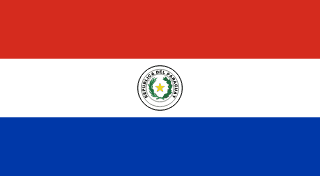
The mburucuyá, a passionflower with a complex structure often interpreted as symbolising the Passion of Christ, is Paraguay's national flower, and the country's flag is one of very few in the world to feature different emblems on each side.
Ñandutí lace, meaning 'spiderweb' in Guaraní, is Paraguay's most distinctive craft tradition, an intricate circular lace pattern historically made by hand in the town of Itauguá. Paraguay is also one of the few countries where an Indigenous language, Guaraní, remains co-official and widely spoken by the general population, not just Indigenous communities specifically.
The Jesuit Missions of La Santísima Trinidad de Paraná and Jesús de Tavarangue, built in the 17th and 18th centuries, are UNESCO World Heritage Sites reflecting a distinctive period of Jesuit-Guaraní cooperation before the order's expulsion.
Paraguay's Gran Chaco region, a vast dry forest shared with Argentina and Bolivia, supports jaguars, giant anteaters, and one of the last strongholds of the Chacoan peccary, a species once believed extinct until rediscovered in the 1970s.
Paraguay is majority Roman Catholic, and Guaraní cultural and linguistic heritage remains unusually well integrated into mainstream national identity compared to many other Latin American countries, reflected in the language's official, everyday status.
Paraguay is a significant exporter of soybeans and beef, with agriculture forming an especially large share of the country's economy relative to its population.
Independence Day on May 14th and 15th marks 1811, when Paraguay declared sovereignty from Spain, one of the earliest such declarations in South America, celebrated over two full days. Founding of Asunción Day on August 15th marks 1537, treating the capital's founding as a significant historical milestone in its own right, and Boqueron Battle Day in September commemorates a decisive 1932 victory during the Chaco War with Bolivia.
Football holds the largest domestic following in Paraguay by a wide margin, the national team having reached the World Cup quarter-finals in 2010, the most successful result in the country's football history. Paraguay also has a strong domestic tradition in a fast indigenous ball sport, and rowing has produced some of the country's more recent international sporting recognition.
Paraguay is a presidential republic, with a President serving as both head of state and government, elected for a single five-year term. The country was ruled by dictator Alfredo Stroessner for 35 years until 1989, one of the longest continuous authoritarian rules in modern Latin American history, and Paraguay has operated under a democratic system since his removal. Paraguay's political system has been dominated for decades by the Colorado Party, one of the longest continuous single-party political dominances in the Americas.
Cerro Peró is Paraguay's highest point at 842 metres, reflecting the country's generally flat, low terrain across both its eastern farmland and western Chaco region. The lowest point is where the Paraguay River exits the country, sitting around 46 metres above sea level, Paraguay's lowest point despite being well above true sea level, since the country is entirely landlocked.
There's no especially close match for Paraguay's flag globally, though its own most distinctive feature, carrying a genuinely different design on each side, front and back, one of the only national flags in the world to do so, makes any comparison somewhat beside the point, since no other flag replicates that structural quirk at all.
Adopted in 1842, notable for being one of the only national flags in the world with a different design on each side, a rare and deliberately unusual choice.
One of only two landlocked countries in South America, alongside Bolivia.
Play today's Flagpie →© Flagpie 2026