
Oceania
Papua New Guinea occupies the eastern half of the island of New Guinea, just north of Australia, sharing its only land border with Indonesia to the west.
Papua New Guinea's name combines 'Papua,' possibly derived from a Malay word describing the frizzy hair of local inhabitants as seen by early traders, with 'New Guinea,' given by a Spanish explorer who thought the coastal people resembled those of Guinea in West Africa.
Landscape: Extremely mountainous and heavily forested, occupying the eastern half of the island of New Guinea alongside hundreds of smaller islands.
Climate: Tropical, hot and humid with a wet season, cooler in the mountainous highlands.
Food: Mumu, meat and vegetables slow-cooked in an underground pit, is a traditional dish shared across much of the Pacific.
Port Moresby was founded in 1873 by a British explorer and named after his father, an admiral, later becoming capital of independent Papua New Guinea in 1975. With a population of around 400,000, it remains the country's dominant political and economic centre, though much of the wider country remains extremely rural and linguistically fragmented.
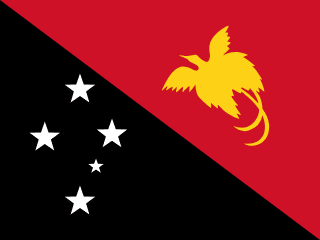
The raggiana bird-of-paradise, with its extraordinary, elaborate plumage, is Papua New Guinea's national bird, appearing on the flag itself, and reflects the country's status as home to more bird-of-paradise species than anywhere else on Earth.
Papua New Guinea's craft traditions are extraordinarily varied given the country's more than 800 distinct languages, the most of any country in the world, including intricate mask-making, wood carving, and bilum bag weaving, each with countless distinct regional and tribal styles.
The Kokoda Track, a historic wartime trail through dense mountainous jungle, holds deep significance tied to fighting during the Second World War, and the highlands region hosts elaborate annual sing-sing festivals showcasing the country's extraordinary cultural diversity.
Papua New Guinea is home to more bird-of-paradise species than any other country, alongside tree kangaroos and an extraordinary range of species reflecting the island's status as one of the most biodiverse and least explored regions on Earth.
Papua New Guinea is majority Christian, though traditional beliefs and practices remain significant, particularly in more remote highland communities, and the country's linguistic diversity, with over 800 distinct languages, is unmatched anywhere else in the world.
Papua New Guinea is a significant exporter of natural gas, gold, and copper, alongside coffee and palm oil, with mining and energy resources forming a substantial and growing share of the national economy.
Independence Day on September 16th marks 1975, when Papua New Guinea gained sovereignty from Australian administration. Remembrance Day in July honours those who died during fighting on Papua New Guinean soil during the Second World War, and given the country's extraordinary linguistic and ethnic diversity, regional and tribal celebrations, including elaborate sing-sing festivals, remain hugely significant across different areas. Papua New Guinea's National Repentance Day in August combines Christian observance with reflection on national unity.
Rugby league holds a place in Papua New Guinean national identity matched by no other sport in the country, treated with a level of devotion that makes it genuinely the national sport, unusual for the Pacific region where rugby union or football more commonly dominate. Australian rules football also draws a significant following given the country's close historical ties to Australia.
Papua New Guinea is a parliamentary constitutional monarchy, with the British monarch as ceremonial head of state represented domestically by a Governor-General, while a Prime Minister holds real executive power accountable to a single-chamber parliament. The country's extraordinary linguistic diversity, with over 800 distinct languages, the most of any nation on Earth, has significantly shaped its political structure, built around accommodating enormous local and regional variation. Papua New Guinea holds significant gold, copper, and natural gas reserves central to its export economy.
Mount Wilhelm is Papua New Guinea's highest point at 4,509 metres. The lowest point sits at sea level around the country's coastline and many islands. Papua New Guinea's extremely mountainous and forested terrain has historically limited transport infrastructure between regions.
There's no especially close match for Papua New Guinea's flag, the diagonal split between a red field bearing a bird-of-paradise and a black field bearing the Southern Cross constellation is a genuinely distinctive combination, that diagonal division specifically not closely echoed by most other national flags.
Designed by Susan Karike.
Adopted in 1971, designed by a 15-year-old schoolgirl through a national design competition.
One of the most linguistically diverse places on Earth, with over 800 languages spoken.
Play today's Flagpie →© Flagpie 2026