
North America
Panama sits at the very southern tip of Central America, bordered by Costa Rica to the west and Colombia to the east, connecting North and South America and separating the Pacific Ocean from the Caribbean Sea.
Panama's name origin is debated, with the most popular explanation tracing it to an Indigenous word meaning 'abundance of fish' or 'many butterflies,' referring to a fishing village that once stood near the site of modern Panama City.
Landscape: A narrow isthmus connecting North and South America, mountainous and heavily forested, bisected by the Panama Canal.
Climate: Tropical, hot and humid year-round with a pronounced wet season.
Food: Sancocho, a chicken and vegetable stew, is widely considered the national dish.
Panama City was founded by Spanish conquistador Pedro Arias Dávila in 1519, making it one of the oldest continuously inhabited European-founded cities on the Pacific coast of the Americas. With a population of around 900,000, it grew significantly in importance following the completion of the Panama Canal in 1914, which the city sits alongside.
The harpy eagle, one of the largest and most powerful eagles in the world, is Panama's national bird, found in the country's remaining rainforest. The Holy Ghost orchid is the national flower.
The pollera, an elaborately embroidered traditional dress, is considered Panama's national costume and can take months to complete by hand. The mola, a colourful reverse-appliqué textile made by the Indigenous Guna people, is another significant Panamanian craft tradition.
The Panama Canal, connecting the Atlantic and Pacific Oceans, remains the country's single most significant landmark and a feat of early 20th-century engineering, and Casco Viejo, Panama City's historic quarter, is a UNESCO World Heritage Site.
The harpy eagle and Baird's tapir are both found in Panama's rainforests, and the country's position as a land bridge between North and South America makes it an important corridor for wildlife migration between the two continents. Panama's Coiba National Park protects one of the largest remaining coral reef systems in the eastern Pacific, home to significant shark and whale populations.
Panama is majority Roman Catholic, and the country's population reflects a mix of Indigenous, Spanish, African, and more recent Chinese and Caribbean immigrant heritage, particularly tied to labour brought in for canal construction.
Panama's economy is heavily built around the Panama Canal and related shipping and logistics services, alongside banking, with the country serving as a significant regional financial centre.
Independence Day from Colombia on November 3rd marks 1903, when Panama separated to become its own nation, closely tied historically to the subsequent construction of the Panama Canal. Separate Independence Day from Spain on November 28th commemorates the earlier 1821 declaration, giving Panama two distinct independence celebrations within the same month, each marking a different chapter of its history. Panama's Carnival, held in the days before Lent, is one of the country's largest and most colourful annual celebrations.
Baseball holds a particularly significant place in Panamanian sporting culture, unusual for a Central American nation otherwise surrounded by football-dominant neighbours, and the country has produced several notable Major League Baseball players. Football has also grown considerably in popularity in more recent decades. Panamanian boxing has produced multiple world champions across different weight divisions over the decades.
Panama is a presidential republic, with a President serving as both head of state and government, elected for a single five-year term. The Panama Canal, transferred to full Panamanian control in 1999 after being operated by the United States for decades, remains central to the country's economy and national identity. Panama's use of the US dollar alongside its own currency reflects the country's close historic economic ties to the United States.
Volcán Barú, an inactive volcano, is Panama's highest point at 3,474 metres, and on a clear day, it's possible to see both the Pacific Ocean and Caribbean Sea from its summit. The lowest point sits at sea level along Panama's coastlines on both oceans.
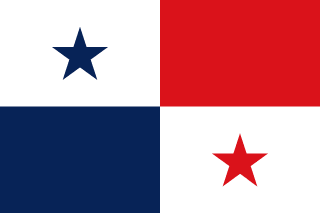
There's no especially close match for Panama's flag, the four-quadrant design combining red, blue, and white with a star in two of the quadrants is distinctive enough as a layout, deliberately designed to represent the country's two main political parties at the time of independence, a structure not closely echoed by any other national flag.
Designed by Manuel Encarnación Amador Guerrero.
Adopted in 1903 immediately after Panama gained independence from Colombia, designed by the son of the country's first president.
Home to over 10,000 plant species and one of the highest concentrations of biodiversity relative to its size.
Play today's Flagpie →© Flagpie 2026