
Oceania
Palau is a nation of hundreds of islands in the western Pacific Ocean, sitting east of the Philippines and north of Indonesia.
Palau's name likely comes from the Palauan word 'Belau,' possibly meaning 'village' or related to a creation story involving the islands being formed from a giant stone, with the current spelling reflecting Spanish and later other colonial-era transliteration.
Landscape: An archipelago of volcanic and coral islands, including the famous Rock Islands, known for their mushroom-like shape carved by erosion.
Climate: Tropical, warm and humid year-round with a wet season.
Food: Fish, taro, and cassava form the basis of traditional Palauan meals.
Ngerulmud became Palau's capital in 2006, a purpose-built government centre on the island of Babeldaob, replacing Koror, the country's largest city and continuing commercial centre. With a very small population, Ngerulmud remains primarily an administrative site.
The dugong, a large marine mammal related to the manatee, is closely associated with Palau's marine conservation identity, and traditional Palauan storyboards, carved wooden panels depicting legends and history, are a distinctive cultural symbol.
Palauan storyboard carving, depicting traditional legends in relief on wooden panels, has become internationally recognised, and traditional Palauan bai meeting houses, elaborately decorated communal buildings, reflect the country's historic architectural and storytelling traditions. Traditional Palauan money, made from glass beads and other materials passed down through generations, still holds ceremonial value in specific cultural exchanges today.
The Rock Islands Southern Lagoon, a UNESCO World Heritage Site made up of hundreds of mushroom-shaped limestone islands, is Palau's most significant natural landmark, including Jellyfish Lake, home to millions of harmless, stingless jellyfish.
Jellyfish Lake's population of golden jellyfish, which lost their sting over thousands of years of isolation from predators, represents one of the more unusual wildlife phenomena anywhere in the world.
Palau is majority Christian, with the country having designated itself the world's first shark sanctuary in 2009, reflecting a particularly strong national commitment to marine conservation woven into both policy and cultural identity. Palauan society traditionally follows a matrilineal structure, with clan leadership and land inheritance passed through the female line.
Palau's economy relies overwhelmingly on tourism, particularly diving given its exceptional marine biodiversity, rather than significant goods exports, given the country's very small size and limited industrial base.
Independence Day on October 1st marks 1994, when Palau gained full sovereignty, one of the most recently independent nations in the world. Senior Citizens Day honours elders within Palauan society, reflecting the significant cultural respect traditionally given to older generations in Palauan and wider Pacific custom. Palau's Youth Day celebrates the country's younger generation with community sporting events. Palau's Constitution Day in July marks the country's founding legal framework.
Weightlifting and outrigger canoe racing both hold cultural significance in Palau, similar to other Pacific island nations, and diving has become a significant part of Palau's international sporting and tourism identity given the country's exceptional marine environment. Palauan athletes have also competed in swimming and track events at recent Games. Palauan spearfishing traditions remain practised alongside more modern competitive sports.
Palau is a presidential republic, with a President serving as both head of state and government, elected directly for a four-year term. The country maintains a Compact of Free Association with the United States, providing financial assistance and defence arrangements, and Palau was the first country in the world to formally declare its waters a shark sanctuary, in 2009. Palau's tourism industry, centred on diving and marine conservation, forms a significant part of its economy.
Mount Ngerchelchuus is Palau's highest point at 242 metres. The lowest point sits at sea level throughout the country's islands, including the famous Rock Islands Southern Lagoon. Palau's Rock Islands feature distinctive mushroom-shaped limestone formations carved by centuries of erosion.
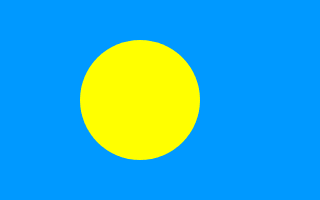
Bangladesh's flag uses a similar single-circle design principle to Palau's, though Bangladesh's is a red circle on green rather than Palau's golden disc on blue, and positioned differently within the field, different enough in colour that confusion between the two specifically is less likely. The off-centre golden disc placement is a deliberate design choice distinguishing it from simpler centred-circle flags.
Adopted in 1981, its simple design of a golden disc slightly off-centre on a blue field was chosen from a national design competition.
Home to a marine lake filled with millions of jellyfish that have lost their sting due to the lake's isolation.
Play today's Flagpie →© Flagpie 2026