
Asia
Pakistan sits in South Asia, bordered by India to the east, China to the northeast, Afghanistan to the west, and Iran to the southwest, with a coastline on the Arabian Sea.
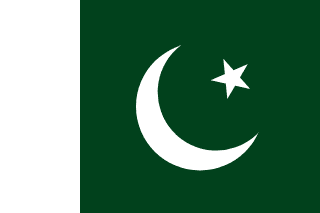
This flag has the highest proportion of dark green of any flag in Flagpie, at 69%.
Pakistan's name was coined in 1933 as an acronym-like construction from the names of its founding regions, Punjab, Afghania, Kashmir, Sindh, and Baluchistan, and also reads as 'land of the pure' in Urdu and Persian.
Landscape: Ranges from the Himalayas and Karakoram mountains in the north to the Indus River plain and the arid Thar Desert further south.
Climate: Mostly arid to semi-arid, with a monsoon season and significant temperature swings between summer and winter.
Food: Biryani and a wide range of kebabs are widely eaten, alongside a strong tradition of curries built on Pakistan's own blend of South Asian spices.
Islamabad was purpose-built as Pakistan's capital, replacing Karachi in the 1960s, chosen for its proximity to the military headquarters in Rawalpindi and its more central, cooler location relative to the sprawling coastal city of Karachi. With a population of around 1.2 million, it remains one of the most carefully planned cities in South Asia.
The markhor, a large wild goat with distinctive spiralling horns, is Pakistan's national animal, found in the country's northern mountain regions. Jasmine is the national flower, and the crescent moon and star, appearing on the national flag, are closely tied to the country's Islamic identity.
The shalwar kameez, a loose tunic and trouser combination, is Pakistan's most widely worn traditional dress for both men and women. Pakistani truck art, elaborately hand-painted decoration covering entire cargo trucks, has become an internationally recognised folk art form in its own right.
The Badshahi Mosque in Lahore, completed in 1673 under the Mughal Empire, remains one of the largest mosques in the world, alongside the ancient ruins of Mohenjo-daro, one of the earliest major cities of the Indus Valley Civilisation, dating back over 4,000 years.
The snow leopard, one of the most elusive big cats in the world, survives in small numbers in Pakistan's northern mountain ranges. The Indus River dolphin, a freshwater species found almost nowhere else, is critically endangered.
Pakistan was founded in 1947 specifically as a homeland for South Asian Muslims and remains overwhelmingly Muslim today, predominantly Sunni, with a significant Shia minority and smaller Christian and Hindu communities.
Pakistan is a significant exporter of textiles, particularly cotton products, along with rice and leather goods, with the textile sector forming one of the largest shares of the national economy.
Independence Day on August 14th marks 1947, when Pakistan was created through the partition of British India, and Pakistan Day on March 23rd commemorates the 1940 Lahore Resolution that first called for a separate Muslim homeland in the region. Eid al-Fitr and Eid al-Adha are both major national celebrations given Pakistan's overwhelmingly Muslim population. Basant, a traditional kite-flying festival marking the arrival of spring, remains celebrated in some regions despite safety-related restrictions introduced in recent years.
Cricket is by far Pakistan's most popular sport, treated with genuine national devotion, and the country's 1992 World Cup win remains one of its most celebrated sporting achievements. Field hockey holds significant historical weight too, Pakistan having been a dominant Olympic and World Cup force in the sport through the mid-20th century, and squash has produced several of the sport's most successful world champions.
Pakistan is a federal parliamentary republic, with a largely ceremonial President as head of state and a Prime Minister holding real executive power, accountable to a bicameral parliament. The country has alternated between periods of civilian democratic rule and military governance since independence in 1947, and its 1973 constitution, though suspended at various points, remains the country's foundational legal document.
K2, on the border with China, is Pakistan's highest point at 8,611 metres, the second-highest mountain on Earth after Everest and widely considered one of the most technically difficult and dangerous major peaks to climb. The lowest point sits at sea level along Pakistan's Arabian Sea coastline.
Turkey's flag shares the same crescent-and-star symbolism Pakistan's does, though on a plain red field rather than Pakistan's green-and-white design with its distinctive vertical white stripe at the hoist, different enough overall that the two aren't especially likely to be confused. Algeria's flag also carries a crescent and star on green and white, arranged quite differently, a vertical split rather than Pakistan's stripe-and-field layout, similar in spirit but distinct enough in structure.
Designed by Ahmad Saeed Kirmani.
Adopted in 1947 at independence from Britain, based on the flag of the All-India Muslim League, with a white stripe added to represent religious minorities.
Home to K2, the second-highest mountain on Earth and considered one of the most dangerous to climb.
Play today's Flagpie →© Flagpie 2026