
Europe
North Macedonia is a landlocked country on the Balkan Peninsula, bordered by Kosovo and Serbia to the north, Bulgaria to the east, Greece to the south, and Albania to the west.
North Macedonia's name comes from the ancient kingdom of Macedon, homeland of Alexander the Great, with 'North' formally added to the country's name in 2019 specifically to resolve a decades-long naming dispute with Greece, which has its own northern region also called Macedonia.
Landscape: Landlocked and mountainous, home to Lake Ohrid, one of the oldest and deepest lakes in Europe.
Climate: Continental, warm summers and cold winters, with a Mediterranean influence in the south.
Food: Tavče gravče, baked beans cooked in a clay pot, is widely considered the national dish.
Skopje has been a significant city for over 2,000 years, and became capital of modern North Macedonia following Yugoslav-era autonomy and eventual independence in 1991. With a population of around 600,000, the city was substantially rebuilt after a devastating 1963 earthquake, and more recently underwent a controversial large-scale monument-building project in the city centre.
The lion appears prominently on North Macedonia's coat of arms, and the sun symbol from Kutleš, an ancient artefact discovered in the country, has become a significant, if occasionally contested, national symbol tied to claims of connection with ancient Macedonian heritage.
Macedonian traditional dress varies significantly by region, often featuring intricate embroidery, and traditional Macedonian copperwork and wood carving remain practised crafts, particularly around the historic town of Ohrid. Traditional Macedonian wine-making, particularly in the Tikveš region, has ancient roots and remains a genuinely significant part of the country's agricultural identity.
Lake Ohrid, one of the oldest and deepest lakes in Europe, and the surrounding historic town, both a UNESCO World Heritage Site, reflect thousands of years of continuous settlement and religious significance.
Lake Ohrid supports numerous endemic species found nowhere else, a result of the lake's extraordinary age, believed to be between one and ten million years old.
North Macedonia is majority Orthodox Christian, with a significant ethnic Albanian Muslim minority, and the country's relationship with its name and ancient Macedonian heritage has been a significant and sometimes contentious part of its modern national identity and regional diplomacy.
North Macedonia is a significant exporter of textiles, iron and steel products, and machinery, with a manufacturing base increasingly integrated into the wider European supply chain.
Independence Day on September 8th marks 1991, when North Macedonia declared sovereignty following the breakup of Yugoslavia. Republic Day on August 2nd, also Saints Cyril and Methodius Day, marks the 1903 Ilinden Uprising against Ottoman rule, a date of deep significance to Macedonian national identity. Skopje's Jazz Festival each October has grown into a significant regional cultural draw.
Handball holds a particularly significant place in North Macedonian sporting culture, the national team having achieved notable success at the European level relative to the country's small population. Football also draws a significant domestic following. North Macedonian athletics has produced notable competitors at continental championships.
North Macedonia is a parliamentary republic, with a directly elected President serving a largely ceremonial role and a Prime Minister holding real executive power, accountable to a single-chamber Assembly. The country's decades-long naming dispute with Greece, resolved in 2019 with the adoption of its current name, cleared the way for North Macedonia's subsequent NATO membership. North Macedonia's economy relies significantly on textiles, agriculture, and a growing manufacturing sector.
Golem Korab, on the border with Albania, is North Macedonia's highest point at 2,764 metres. The lowest point is along the Vardar River where it exits the country, sitting around 50 metres above sea level, North Macedonia's lowest point despite being well above true sea level, since the country is entirely landlocked. North Macedonia's mountainous terrain covers much of the country, with fertile valleys along its major rivers.
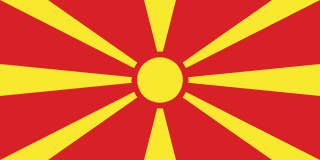
There's no especially close match for North Macedonia's flag, the golden sun with rays extending to the flag's edges on a red field is a distinctive design, deliberately adopted in 1995 to replace an earlier version using the ancient Vergina Sun symbol after Greece objected that it was part of Greek historical heritage. The country's sun emblem is entirely distinct from the crescent-and-star symbolism used across much of the wider Balkans.
Adopted in 1995, replacing an earlier version that used the ancient Vergina Sun symbol, changed after Greece objected that the symbol was part of its own historical heritage.
Home to Lake Ohrid, one of the oldest lakes in the world and a UNESCO World Heritage Site.
Play today's Flagpie →© Flagpie 2026