
Africa
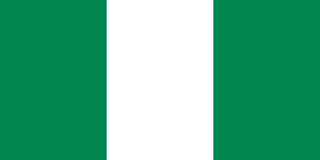
Nigeria sits on the Gulf of Guinea coast of West Africa, bordered by Benin to the west, Niger to the north, Chad to the northeast, and Cameroon to the east. It's also named after the Niger River.
Nigeria's name comes from the Niger River, which runs through the country, itself possibly derived from a Tuareg phrase referring to a river, or alternatively from the Latin word 'niger' meaning black, applied by early European geographers.
Landscape: Ranges from coastal mangrove swamps in the south to tropical rainforest, savanna, and semi-desert in the far north.
Climate: Tropical in the south, becoming drier and more arid moving north toward the Sahara.
Food: Jollof rice is a source of good-natured rivalry with Ghana over which country does it best, alongside pounded yam and a wide range of pepper soups.
Abuja was purpose-built as Nigeria's capital, replacing Lagos in 1991, chosen partly for its central location and neutral position relative to the country's major ethnic and religious groups, similar in spirit to how Brasília and Canberra were chosen. With a population of around 3.6 million, it remains far smaller than Lagos, which continues to function as the country's commercial and cultural centre.
The black-crowned crane is Nigeria's national bird, known for its distinctive golden crest, and appears on the country's coat of arms alongside two horses representing dignity. The eagle is another widely used unofficial symbol of strength and vision in Nigerian national identity.
Nigeria has extremely varied craft traditions given its size and ethnic diversity, from Yoruba adire tie-dye textiles to intricate Benin bronze casting, a technique dating back centuries and considered among the finest metalwork traditions in African history.
The Zuma Rock, a massive monolith near Abuja, is one of Nigeria's most recognisable natural landmarks, alongside the ancient walls of Kano, one of West Africa's oldest continuously inhabited cities, and the Osun-Osogbo sacred grove, a UNESCO World Heritage Site tied to Yoruba religious tradition.
Nigeria is home to forest elephants and chimpanzees in its remaining rainforest regions, though habitat loss has significantly reduced both populations. The Cross River gorilla, one of the rarest primates in the world, survives only in a small border region shared with Cameroon.
Nigeria is roughly split between a Muslim-majority north and a Christian-majority south, one of the most religiously balanced large populations in the world, alongside significant traditional African religious practices still observed in parts of the country. It's also home to over 250 distinct ethnic groups, with Hausa, Yoruba, and Igbo among the largest.
Nigeria is Africa's largest oil producer and one of the world's top exporters of crude oil, though the economy has been diversifying in recent years toward agriculture, telecommunications, and a rapidly growing film industry, Nollywood, one of the largest in the world by volume of films produced.
Independence Day on October 1st marks 1960, when Nigeria gained independence from Britain, becoming one of the most populous nations to do so during that era of African decolonisation. Eid al-Fitr and Eid al-Adha are both widely observed given Nigeria's large Muslim population concentrated particularly in the north, and Christmas is celebrated with similar enthusiasm across the largely Christian south. Argungu Fishing Festival in the north, though regional rather than national, draws thousands for a dramatic mass fishing competition tied to centuries of local tradition.
Football is Nigeria's dominant sport, the national team, nicknamed the Super Eagles, having won the Africa Cup of Nations multiple times and produced numerous players who've gone on to star for major European clubs. Nigeria has also become one of Africa's strongest Olympic track and field programmes in recent decades.
Nigeria is a federal presidential republic, Africa's most populous country and one of its largest democracies, with a President serving as both head of state and government. The country's 36 states are deliberately structured to balance the interests of its major ethnic and religious groups, a structural response to the deep regional divisions that contributed to a brutal civil war in the late 1960s.
Chappal Waddi, near the border with Cameroon, is Nigeria's highest point at 2,419 metres, sitting within a mountainous region that's home to significant biodiversity. The lowest point sits at sea level along Nigeria's Atlantic coastline in the Niger Delta.
Ireland's flag uses the exact same green-white-green vertical layout Nigeria does, purely by coincidence rather than any historical connection between the two, and the resemblance is close enough that the two are genuinely easy to mix up unless you already know which is which. Mali and Senegal both use green in their own flags too, but in different arrangements alongside yellow and red rather than Nigeria's plain green-white-green, different enough not to cause real confusion.
Designed by Michael Taiwo Akinkunmi.
Chosen via a national design competition ahead of independence in 1960. The original design included a red sun, which was removed by the selection committee before adoption.
Home to well over 500 recorded languages, more than almost any other country on Earth.
Play today's Flagpie →© Flagpie 2026