
Africa
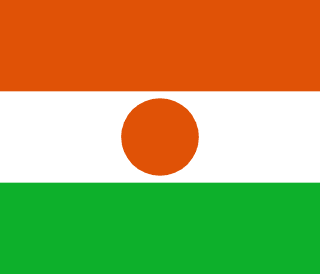
Niger is a landlocked country in West Africa, bordered by Algeria and Libya to the north, Chad to the east, Nigeria and Benin to the south, and Burkina Faso and Mali to the west. It's named after the Niger River.
This flag has the highest proportion of orange of any flag in Flagpie, at 39%.
Niger's name comes from the Niger River, which runs through the southwestern part of the country, itself possibly derived from a Tuareg phrase referring to a river, or a Latin-influenced European misreading of local names.
Landscape: Landlocked, over 80% covered by the Sahara Desert, with the Niger River providing the only significant fertile strip.
Climate: Hot and arid across most of the country, one of the hottest countries on Earth.
Food: Millet-based dishes are the everyday staple, typically served with a vegetable or meat sauce.
Niamey has served as Niger's capital since French colonial times, growing from a small fishing and farming village on the Niger River into the country's dominant political and economic centre. With a population of around 1.3 million, it remains one of the fastest-growing cities in the Sahel region.
The addax, a critically endangered desert antelope with distinctive spiralling horns, is closely tied to Niger's Saharan wildlife heritage, though it has become exceptionally rare in the wild.
Tuareg silverwork, particularly the distinctive Agadez cross, a regionally specific pendant design, is one of Niger's most internationally recognised craft traditions, and traditional leatherwork among Fula and Hausa communities remains significant.
The Aïr and Ténéré Natural Reserves, a UNESCO World Heritage Site, protect a vast area of Saharan desert and mountain terrain, and the Grand Marché in Niamey reflects the country's significant role in regional Sahel trade.
Niger's W National Park, part of a larger cross-border protected area shared with Benin and Burkina Faso, protects some of the last significant elephant and lion populations remaining in the wider Sahel region.
Niger is overwhelmingly Muslim, and the country is home to several major ethnic groups, including the Hausa, Zarma, and Tuareg, with Tuareg nomadic culture in particular remaining a significant, if increasingly challenged, way of life in the country's desert north. Niger holds the distinction of having one of the youngest populations in the world by median age, reflecting a very high birth rate relative to most other countries.
Niger is a significant exporter of uranium, one of the larger global producers, alongside livestock, with mining forming a substantial share of the country's limited formal export economy.
Independence Day on August 3rd marks 1960, when Niger gained sovereignty from French colonial rule. Given Niger's overwhelmingly Muslim population, Eid al-Fitr and Eid al-Adha are both major national holidays, celebrated with particular significance in a country where Islam shapes much of daily social life. Concord Day in April marks a 1995 peace agreement ending a significant internal Tuareg rebellion. National Day celebrations often feature traditional camel and horse parades.
Football holds the largest domestic following in Niger by a wide margin, even without major international competitive success to match, and traditional wrestling remains practised across various regions, tied to specific ethnic customs shared with several neighbouring Sahel nations. Niger's basketball programme has grown through increased regional West African competition. Niger's traditional camel racing remains a genuinely popular rural pastime.
Niger's political situation has been in significant flux in recent years, having experienced a military coup in 2023 amid ongoing security challenges from extremist violence across the wider Sahel region, with the country currently governed by a military transitional authority rather than an elected civilian government. Niger holds significant uranium reserves, a resource central to its relationship with international nuclear energy markets.
Mont Idoukal-n-Taghès, in the Aïr Mountains, is Niger's highest point at 2,022 metres. The lowest point is along the Niger River valley, sitting around 200 metres above sea level, Niger's lowest point despite being well above true sea level, since the country is entirely landlocked. Niger's largely flat, arid terrain is broken by the Aïr Mountains rising dramatically from the surrounding Sahara.
India's flag uses a similar saffron-white-green horizontal layout to Niger's, though India carries a detailed navy Ashoka Chakra wheel where Niger has a plain orange disc, making the two genuinely similar from a distance despite the different central symbol. Mali also once used a similar orange sun symbol before adopting its current plain tricolour design.
Adopted in 1959, one of the few African flags whose central emblem represents the sun rather than a star.
One of the hottest countries on Earth, with much of its territory covered by the Sahara Desert.
Play today's Flagpie →© Flagpie 2026