
North America
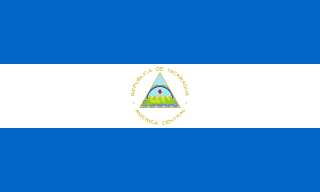
Nicaragua is the largest country in Central America, bordered by Honduras to the north and Costa Rica to the south, with coastlines on both the Caribbean Sea and the Pacific Ocean.
Nicaragua's name comes from Nicarao, a powerful Indigenous chief who ruled the area around Lake Nicaragua when Spanish explorers first arrived, combined with 'agua,' the Spanish word for water, referencing the region's significant lakes.
Landscape: Includes a Pacific lowland region with major lakes and volcanoes, central highlands, and a sparsely populated Caribbean lowland to the east.
Climate: Tropical, hot with a wet and dry season, cooler in the central highlands.
Food: Gallo pinto, rice and beans, is a shared Central American staple, alongside vigorón, a dish of boiled yuca, pork rind, and cabbage salad.
Managua became Nicaragua's capital in 1852, chosen partly as a compromise between the rival cities of León and Granada, which had long competed for political dominance. With a population of around 1 million, the city was significantly rebuilt following a devastating 1972 earthquake that destroyed much of its historic centre.
The turquoise-browed motmot, shared symbolically with El Salvador, is Nicaragua's national bird, and the sacuanjoche, a fragrant white flower, is the national flower, most fragrant at night to attract its natural moth pollinators.
Nicaraguan pottery from the town of San Juan de Oriente and traditional hammock weaving from Masaya remain significant living craft traditions, and Nicaraguan folkloric dance, particularly linked to the historic city of León, reflects deep colonial and Indigenous cultural blending.
Lake Nicaragua, the largest lake in Central America and one of very few freshwater lakes in the world to contain ocean-adapted bull sharks, and the colonial city of Granada, one of the oldest European-founded cities in the Americas, are among Nicaragua's most significant landmarks.
Lake Nicaragua's population of freshwater bull sharks, adapted from their usual ocean habitat, represents one of the more unusual wildlife phenomena in the Americas, and the country's Indio Maíz Biological Reserve protects significant rainforest along the Caribbean coast.
Nicaragua is majority Roman Catholic, with a growing evangelical Protestant population, and the country's Caribbean coast is home to a distinct Afro-Caribbean and Indigenous Miskito population with its own language and cultural traditions separate from the Spanish-speaking Pacific side of the country.
Nicaragua is a significant exporter of coffee, beef, and gold, with agriculture forming a substantial share of the country's export economy.
Independence Day on September 15th, shared with the rest of Central America, marks 1821, celebrated with student parades and torch relays nationwide. Given Nicaragua's significant Catholic population, patron saint festivals remain genuinely significant local celebrations across the country's towns and cities throughout the year. Nicaragua's Liberation Day in July marks the 1979 revolution that ended the Somoza family's decades-long rule.
Baseball, unusually for Central America, holds the largest following in Nicaragua rather than football, a legacy of early 20th-century American influence, and the country has produced several Major League Baseball players despite its comparatively small population. Boxing has also produced multiple Nicaraguan world champions across different weight divisions. Nicaraguan athletics has grown through increased Central American regional competition.
Nicaragua is a presidential republic, with a President serving as both head of state and government. The country's more recent politics have been shaped significantly by the government's increasingly authoritarian turn, including widespread crackdowns on political opposition, independent media, and civil society following major protests in 2018. Nicaragua's economy relies significantly on coffee and agricultural exports alongside a growing manufacturing sector. Nicaragua's Lake Nicaragua is the largest lake in Central America and home to freshwater bull sharks. Nicaragua's canal proposal, though never built, was once seriously considered as an alternative to Panama's.
Mogotón is Nicaragua's highest point at 2,107 metres. The lowest point sits at sea level along Nicaragua's coastlines on both the Pacific and the Caribbean. Nicaragua's terrain includes significant volcanic activity and two major lakes, Lake Nicaragua and Lake Managua.
Honduras, El Salvador, and Guatemala all use variations of the same blue-white-blue tricolour tracing back to the former United Provinces of Central America, and Nicaragua's own detailed triangular coat of arms featuring five volcanoes, representing the five founding nations, closely echoes El Salvador's near-identical emblem, making the two flags genuinely easy to mix up without a careful look.
Based on the flag of the United Provinces of Central America, readopted in its current form in 1971.
Home to Lake Nicaragua, one of the only lakes in the world with freshwater sharks.
Play today's Flagpie →© Flagpie 2026