
Oceania
New Zealand consists of two main islands in the southwestern Pacific Ocean, sitting roughly 1,500 kilometres southeast of Australia across the Tasman Sea.
New Zealand's name comes from the Dutch province of Zeeland, applied by Dutch explorer Abel Tasman's cartographers after his 1642 voyage, though he himself never landed there. The Māori name for the country, Aotearoa, is generally translated as 'land of the long white cloud.'
Landscape: Two main islands dominated by mountains, geothermal activity, and fjords, with a notably long coastline relative to its size.
Climate: Temperate maritime, mild throughout the year with no extreme seasons, though the South Island's mountains see significant snow.
Food: A meat pie and pavlova (a dessert Australia also claims to have invented) are among the best known local foods, alongside a strong lamb-farming tradition.
Wellington became New Zealand's capital in 1865, replacing Auckland, chosen largely for its more central location between the North and South Islands at a time when transport between the two was slow and difficult. With a population of around 215,000 in the city itself, it remains considerably smaller than Auckland but holds Parliament and the country's main government institutions.
The kiwi, a small flightless bird found nowhere else in the world, is New Zealand's most recognisable national symbol, lending its name informally to New Zealanders themselves. The silver fern, native to New Zealand's forests, appears widely in national sporting emblems, including the All Blacks rugby team.
Māori carving, particularly in wood and pounamu (greenstone), carries deep cultural and spiritual significance, with specific patterns and designs traditionally passed down within particular tribal groups. Māori weaving, using native flax, produces cloaks and other items still made and worn for significant ceremonial occasions today.
Milford Sound, a dramatic fiord in the South Island, is one of New Zealand's most photographed natural landmarks, alongside the geothermal region around Rotorua, home to geysers and hot springs central to Māori cultural sites.
New Zealand's long isolation produced a huge number of species found nowhere else, including the kiwi and the tuatara, a reptile considered a living link to the age of dinosaurs. The country has no native land mammals aside from bats, making its birdlife especially distinctive.
New Zealand has become increasingly secular, with a large and growing share of the population identifying with no religion, though Christianity remains the largest single faith group. Māori culture holds official recognition alongside European settler culture, with te reo Māori an official language and the Treaty of Waitangi forming a foundational document of the country's governance.
New Zealand is a major exporter of dairy products, meat, and wine, with agriculture forming an especially large share of its export economy relative to its small population.
Waitangi Day on February 6th marks the 1840 signing of the Treaty of Waitangi between the British Crown and Māori chiefs, the country's founding document, and remains a date of genuine ongoing national significance and occasional debate regarding the treaty's interpretation and honouring. ANZAC Day on April 25th, shared with Australia, commemorates military personnel who served and died in past conflicts, marked with dawn services nationwide.
Rugby union holds a place in New Zealand's national identity matched by few other countries and any other sport worldwide, the All Blacks' pre-match haka having become one of the most recognised sporting traditions on Earth. Netball and cricket also both hold significant followings, and New Zealand has a strong sailing tradition, including multiple America's Cup victories.
New Zealand is a parliamentary constitutional monarchy, with the British monarch as ceremonial head of state represented domestically by a Governor-General, while a Prime Minister holds real executive power accountable to a single-chamber Parliament. New Zealand was the first self-governing country in the world to grant women the right to vote, in 1893, a genuinely significant milestone in global democratic history.
Aoraki / Mount Cook, in the Southern Alps, is New Zealand's highest point at 3,724 metres, held sacred by Ngāi Tahu, the local Māori tribe, whose name for the mountain is now officially used alongside the English one. The lowest point sits at sea level along the country's extensive coastline.
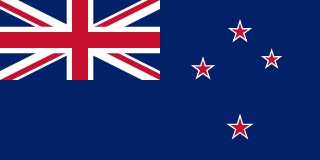
Australia's flag is New Zealand's closest match by a wide margin, both carry the Union Jack in the canton with stars representing the Southern Cross in the fly, differing mainly in exact star count and colour, New Zealand uses four red stars with white borders, Australia uses six white stars including an additional Commonwealth Star. A 2016 referendum on changing New Zealand's flag specifically to reduce this confusion was held and narrowly voted down, keeping the current design.
Adopted in 1902, based on the Blue Ensign used by the colony since the 1860s. A 2016 referendum on changing the design was held and voted down, keeping the current flag.
Has a surprisingly long coastline for its size, over 15,000 km, thanks to its many bays and inlets.
Play today's Flagpie →© Flagpie 2026