
Asia
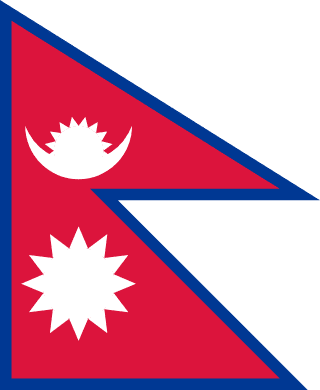
Nepal is a landlocked country in the Himalayas, wedged between China to the north and India surrounding its other borders, home to Mount Everest.
Nepal's name origin is debated, one theory traces it to 'Ne,' a sage figure in Hindu tradition, combined with 'pala,' meaning protected, giving a meaning close to 'protected by Ne,' though this remains one of several competing explanations.
Landscape: Spans the Himalayas, including Mount Everest, down through hills and a fertile lowland plain (the Terai) along the Indian border.
Climate: Varies enormously by altitude, subtropical in the lowlands, alpine and freezing at high elevation.
Food: Dal bhat, lentils and rice typically served with vegetables, is the everyday national staple, alongside momos, steamed dumplings.
Kathmandu has been a significant city for well over a thousand years, historically the centre of the Kathmandu Valley's several competing royal city-states before unification under the Gorkha kingdom in the 18th century. With a population of around 1.5 million, it remains Nepal's political, cultural, and religious centre, home to numerous UNESCO-listed temple complexes within the city itself.
The cow, considered sacred in Hindu tradition, is Nepal's national animal, and the rhododendron, blooming vividly across the country's hillsides each spring, is the national flower.
Nepalese thangka painting, intricate Buddhist scroll art depicting deities and mandalas, is a significant living craft tradition, and Nepalese wood carving, particularly the elaborately decorated temple struts found throughout Kathmandu Valley, reflects centuries of skilled Newar craftsmanship. Nepalese Dhaka fabric weaving, used for traditional topi caps and clothing, remains a distinctive and actively produced regional textile craft.
Mount Everest, the world's highest peak, straddles Nepal's border with Tibet and remains the country's most internationally significant landmark, and the Kathmandu Valley itself contains seven separate UNESCO World Heritage Sites within a relatively small area.
Nepal's Chitwan National Park protects significant populations of one-horned rhinoceros and Bengal tigers, while its high Himalayan regions are home to snow leopards and red pandas.
Nepal is majority Hindu, with a significant Buddhist population, and the two traditions have historically coexisted closely, with many temples and shrines shared or blended between them, reflecting the country's unique religious landscape.
Nepal is a significant exporter of textiles and carpets, alongside agricultural products, and tourism, particularly trekking and mountaineering, forms a substantial part of the national economy.
Dashain in autumn is Nepal's longest and most significant festival, involving family gatherings and the receiving of blessings from elders, and Constitution Day on September 19th marks the 2015 adoption of the country's current constitution following the abolition of the monarchy. Nepalese New Year in mid-April follows the Bikram Sambat calendar, which runs ahead of the Gregorian calendar by well over 50 years.
Football and cricket both hold significant followings in Nepal, though the country's most distinctive sporting identity comes from its mountaineering heritage, Sherpa guides having played an essential role in nearly every major Himalayan expedition since Everest was first summited in 1953. Volleyball has also grown considerably in popularity in recent decades. Traditional Nepalese wrestling and archery remain practised in various regional forms across the country's diverse ethnic communities.
Nepal is a federal parliamentary republic, having abolished its centuries-old monarchy in 2008 following a decade-long civil conflict between government forces and Maoist insurgents. A largely ceremonial President serves as head of state alongside a Prime Minister who holds real executive power, accountable to a bicameral parliament.
Mount Everest, shared with China (Tibet), is Nepal's highest point at 8,849 metres and the tallest mountain on Earth, drawing climbers from around the world despite the considerable danger and expense involved. The lowest point is Kanchan Kalan in the country's southern lowlands, sitting around 70 metres above sea level, Nepal's lowest point despite being well above true sea level, since the country is entirely landlocked. The elevation range within Nepal, from its lowland Terai plains to Everest's summit, is one of the most extreme of any country on Earth relative to its size.
There's no other national flag remotely like Nepal's, it's the only non-rectangular national flag in the world, formed from two overlapping pennant shapes representing the Himalayas and the country's Hindu and Buddhist heritage, a genuinely unique silhouette that couldn't be confused with anything else even if the colours matched another flag exactly.
The double-pennant shape has roots going back centuries, standardised into its exact modern geometric form in the constitution in 1962.
The only country in the world with a non-rectangular national flag, and home to Mount Everest, Earth's highest point.
Play today's Flagpie →© Flagpie 2026