
Oceania
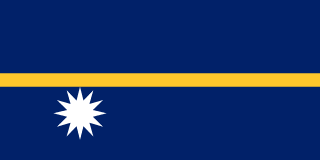
Nauru is a tiny single-island nation in the central Pacific Ocean, the third-smallest country in the world, sitting just south of the Marshall Islands.
This flag has the highest proportion of navy blue of any flag in Flagpie, at 90%.
Nauru's name likely comes from the local word 'Naoero,' the Indigenous name for the island, though the exact original meaning has been debated among linguists and local oral historians.
Landscape: The third-smallest country on Earth, a single small island with a raised phosphate-rich interior and a narrow coastal plain.
Climate: Tropical, hot and humid year-round.
Food: Fish and coconut-based dishes dominate, alongside imported staples given the island's very limited agricultural land.
Nauru has no officially designated capital city, with Yaren serving as the de facto seat of government simply by hosting the country's parliament, an unusual arrangement reflecting the island's tiny overall size of just 21 square kilometres.
The frigate bird, tied to traditional Nauruan fishing and navigation practices, is closely associated with the island, and phosphate rock, the resource that once made Nauru wealthy, remains deeply significant to national economic identity and memory.
Traditional Nauruan handicrafts, including woven pandanus items, remain practised, though the island's small size and historically phosphate-dominated economy meant craft traditions were never as economically central as on some other Pacific nations.
Command Ridge, the island's highest point, offers views across virtually the entire country and holds remnants of Japanese fortifications from the Second World War occupation.
Nauru's surrounding waters support significant tuna populations, central to the country's fishing licence revenue, though the island's own terrestrial wildlife is limited given its small size and history of intensive phosphate mining.
Nauru is majority Christian, and the country holds the distinction of being the third-smallest country in the world by both population and land area, with a national identity shaped significantly by its dramatic economic rise and fall tied to phosphate mining. Nauru briefly became one of the wealthiest nations per capita in the world during the peak of its phosphate exports in the 1970s, a dramatic economic peak the country has never since matched.
Nauru's economy today relies significantly on fishing licence fees and, controversially, revenue from hosting an Australian immigration processing centre, given the near-total exhaustion of the phosphate reserves that once made it one of the wealthiest countries per capita in the world.
Independence Day on January 31st marks 1968, when Nauru gained sovereignty, having previously been administered under a UN trusteeship. Angam Day on October 26th celebrates the recovery of Nauru's population after it was reduced to a critically low number during a wartime deportation and disease crisis, a date of profound significance to national survival and identity. Nauru's Independence Day festivities include traditional dance performances reflecting the island's Pacific heritage. Nauru's small size means most public celebrations genuinely involve the entire island community.
Weightlifting holds a genuinely outsized place in Nauruan sporting identity relative to the country's tiny population, having produced multiple Commonwealth Games medallists in the sport, one of the country's few areas of significant international sporting recognition. Nauruan athletes have also competed in judo and athletics at the Commonwealth Games.
Nauru is a parliamentary republic, with a President elected by and from within parliament serving as both head of state and government. The country's economy has shifted dramatically since its phosphate reserves were largely exhausted, with fishing licence revenue and a controversial arrangement hosting an Australian immigration detention facility now forming significant parts of government income. Nauru briefly became one of the wealthiest nations per capita in the world during peak phosphate exports in the 1970s.
Nauru's highest point sits at around 71 metres along the edge of a central plateau once heavily mined for phosphate. The lowest point sits at sea level around the island's coastline. Nauru's central plateau, once rich in phosphate, remains largely depleted following decades of intensive mining.
There's no especially close match for Nauru's flag, the blue field divided by a narrow gold horizontal stripe representing the equator, with a white 12-pointed star beneath it representing the country's original 12 tribes, is a distinctive and minimalist combination. The single star and equator stripe combination is unique among all current national flags.
Adopted in 1968 at independence, unchanged since.
The smallest island nation in the world, and the third-smallest country on Earth overall.
Play today's Flagpie →© Flagpie 2026