
Africa
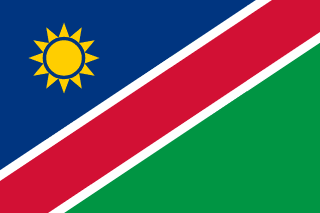
Namibia sits on the Atlantic coast of southern Africa, bordered by Angola and Zambia to the north, Botswana to the east, and South Africa to the south.
Namibia's name comes from the Namib Desert, believed to be the oldest desert in the world, with the desert's own name possibly derived from a Nama word meaning 'vast place' or 'area where there is nothing.'
Landscape: Dominated by the Namib Desert along the coast and the Kalahari further inland, with a central highland plateau.
Climate: Arid to semi-arid, one of the driest countries in sub-Saharan Africa.
Food: Game meat, particularly kudu and springbok, is widely eaten, reflecting the country's extensive wildlife.
Windhoek was founded in 1890 by German colonial forces around natural hot springs already significant to local Indigenous communities, and became capital of independent Namibia in 1990. With a population of around 480,000, it retains notable German colonial architecture, including several buildings still bearing German names.
The oryx (gemsbok), a striking antelope perfectly adapted to desert conditions, is Namibia's national animal, and the welwitschia, an extraordinary desert plant that can live well over a thousand years, is closely tied to national identity.
Namibian Himba jewellery and traditional dress, including distinctive ochre-tinted skin and hairstyling among Himba women, reflect a still actively practised traditional way of life in the country's remote northwest, and San (Bushmen) rock art and craft traditions are among the oldest continuous cultural practices in the world. Namibian basket weaving among the Ovambo people uses distinctive geometric patterns still produced for both everyday and ceremonial use.
The Namib Desert's towering red sand dunes at Sossusvlei, some among the tallest in the world, are Namibia's most photographed landmark, and Etosha National Park, centred on a vast salt pan, is one of Africa's premier wildlife reserves.
Namibia holds the largest free-roaming population of black rhinoceros in the world, alongside desert-adapted elephants and lions found in very few other places on Earth, both remarkably adapted to the country's arid conditions.
Namibia is majority Christian, predominantly Lutheran, a legacy of German colonial missionary activity, and the country recognises numerous ethnic groups, including the Ovambo, Herero, and Himba, alongside a notable German-speaking minority population.
Namibia is a significant exporter of diamonds and uranium, alongside fish products from its rich Atlantic fishing grounds, with mining forming a substantial share of the national economy.
Independence Day on March 21st marks 1990, when Namibia gained sovereignty, the last African country to do so, following a prolonged struggle against South African administration. Heroes' Day in August honours those who died in that liberation struggle, and Cassinga Day in May commemorates a specific and significant 1978 attack during the conflict. Namibia's Human Rights Day in December commemorates a significant 1959 protest against forced removals.
Athletics holds particular significance in Namibian sporting culture, the country having produced notable Olympic sprinters, and rugby and football both also draw significant domestic followings, reflecting Namibia's mixed colonial heritage between German and South African influence. Namibian rugby has also grown considerably given the country's mixed colonial sporting heritage.
Namibia is a presidential republic, with a President serving as both head of state and government. The country was administered by South Africa for decades under a League of Nations and later United Nations mandate before finally achieving independence in 1990, and Namibia's ruling SWAPO party, which led the liberation struggle, has governed continuously since. Namibia's diamond and uranium mining industries remain central to the national economy. Namibia holds one of the lowest population densities of any country in the world.
Königstein, part of the Brandberg Massif, is Namibia's highest point at 2,606 metres. The lowest point sits at sea level along Namibia's Atlantic coastline, much of it bordering the Namib Desert, considered the oldest desert in the world. Namibia's terrain includes the Namib Desert along the coast, considered the oldest desert in the world, and the Kalahari further inland.
There's no especially close match for Namibia's flag, the diagonal band of blue, white, and red dividing green and red triangular sections, topped by a golden sun, is a distinctive and unusual combination, that diagonal split specifically not closely echoed by most other national flags.
Adopted in 1990 upon independence from South Africa, chosen by a national committee that deliberately combined elements from several competing proposals.
One of the least densely populated countries on Earth, home to the ancient Namib Desert, among the oldest deserts in the world.
Play today's Flagpie →© Flagpie 2026