
Africa
Mozambique stretches along the Indian Ocean coast of southeastern Africa, bordered by Tanzania to the north, Malawi and Zambia to the northwest, Zimbabwe to the west, and Eswatini and South Africa to the southwest.
Mozambique's name comes from Mussa Bin Bique, an Arab trader who controlled the island that Portuguese explorers first encountered along the coast, with his name gradually applied to the wider territory that became the Portuguese colony.
Landscape: A long Indian Ocean coastline backed by lowlands, rising to plateau and mountains further inland along the western border.
Climate: Tropical, hot and humid along the coast, with a wet and dry season.
Food: Piri piri chicken, grilled with a fiery chilli sauce, is Mozambique's best known culinary export.
Maputo, originally named Lourenço Marques after a Portuguese explorer, was renamed upon independence in 1975 and has served as the country's capital since Portuguese colonial times. With a population of around 1.1 million, it retains notable Portuguese colonial architecture alongside significant post-independence development.
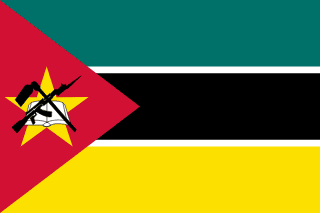
The AK-47 rifle, unusually, appears on Mozambique's flag and coat of arms, a direct reference to the country's armed struggle for independence from Portugal, making it one of the only national flags in the world to depict a modern firearm.
Mozambican wood carving, particularly Makonde sculpture shared culturally with neighbouring Tanzania, is internationally recognised for its intricate, often abstract style, and traditional capulana cloth, brightly patterned fabric worn as everyday dress, remains widely produced and worn.
The Island of Mozambique, a former Portuguese colonial capital and trading post, is a UNESCO World Heritage Site reflecting centuries of Indian Ocean trade, and the Bazaruto Archipelago is known for pristine beaches and marine life.
Gorongosa National Park, significantly restored after decades of civil war devastated its wildlife populations, has become one of Africa's most notable conservation recovery success stories, once again home to lions, elephants, and diverse plains wildlife.
Mozambique is religiously mixed, with significant Christian, Muslim, and traditional African religious populations, and the country's culture reflects centuries of Portuguese colonial influence layered over diverse Bantu ethnic traditions. Traditional healing and spiritual practices remain widely respected in Mozambique, often consulted alongside modern medicine in both rural and urban communities.
Mozambique is a significant exporter of coal, aluminium, and natural gas, with substantial offshore gas discoveries in recent years expected to significantly reshape the country's economy going forward.
Independence Day on June 25th marks 1975, when Mozambique gained sovereignty from Portugal following a lengthy liberation war. Heroes' Day on February 3rd honours those who died in that struggle, and given Mozambique's significant Christian and Muslim populations, both Christmas and Eid holidays are widely observed. Mozambique's Women's Day in April recognises women's role in the country's liberation struggle and society.
Football holds the largest domestic following in Mozambique, and the country has produced notable Olympic success in athletics, particularly middle-distance running, including one of Africa's most celebrated female Olympic champions. Basketball has also grown in domestic popularity in recent years. Mozambican basketball has also grown in domestic popularity in recent years. Mozambican volleyball has also grown steadily in domestic organisation.
Mozambique is a presidential republic, with a President serving as both head of state and government. The country experienced a devastating civil war from 1977 to 1992 following its liberation struggle, and Mozambique's more recent significant offshore natural gas discoveries are expected to substantially reshape its economy in the coming years. Mozambique's significant offshore natural gas discoveries are expected to substantially reshape its economy in coming years. Mozambique's cashew and cotton exports remain significant alongside its growing natural gas sector. Mozambique's Portuguese colonial heritage remains evident in its language and continued Lusophone cultural ties. Its long coastline supports a significant fishing industry alongside its growing energy sector.
Monte Binga is Mozambique's highest point at 2,436 metres. The lowest point sits at sea level along Mozambique's extensive Indian Ocean coastline. Mozambique's terrain includes extensive coastal lowlands rising to highland plateau areas further inland.
There's no especially close match for Mozambique's flag, the green-black-yellow diagonal bands with a red triangle bearing a star, book, hoe, and rifle make it one of the only national flags in the world to depict a modern firearm, a deliberate reference to the country's armed liberation struggle.
Adopted in 1983, a modified version of the flag used by the FRELIMO independence movement, kept the AK-47 despite proposals to remove it after a 2005 design competition failed to produce a clear replacement.
The only country in the world to feature a modern firearm on its national flag.
Play today's Flagpie →© Flagpie 2026