
Africa
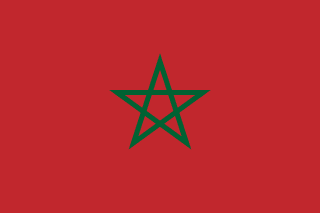
Morocco sits at the northwestern tip of Africa, bordered by Algeria to the east and Western Sahara to the south, with coastlines on both the Atlantic Ocean and the Mediterranean Sea, separated from Spain by the narrow Strait of Gibraltar.
Morocco's English name derives from Marrakesh, one of its historic imperial cities, via Spanish and Portuguese traders who used a version of that city's name to refer to the whole kingdom. Morocco's own Arabic name, Al-Maghrib, means 'the west,' referring to its position at the western edge of the Arab world.
Landscape: Ranges from the Atlas Mountains and Rif Mountains to the Sahara Desert in the south and a long coastline on both the Atlantic and Mediterranean.
Climate: Mediterranean along the coast, becoming increasingly arid moving inland and south toward the Sahara.
Food: Tagine, a slow-cooked stew named after the clay pot it's cooked in, and couscous are the country's best known dishes.
Rabat became Morocco's capital in 1912 under French colonial administration, chosen partly for its coastal position and relative proximity to Europe, replacing the historic imperial cities of Fez and Marrakesh, which had traded the role between them for centuries before. With a population of around 580,000 in the city itself, it remains more understated than Casablanca, Morocco's larger commercial hub.
The Barbary lion, now extinct in the wild, once roamed the Atlas Mountains and remains a powerful symbol of Moroccan heritage, appearing on the country's coat of arms. The rose is closely associated with the Dades Valley region, a major centre of rose cultivation and rosewater production.
Moroccan leatherwork, particularly from Fez's centuries-old tanneries, and intricate zellij tilework, geometric mosaic patterns found throughout Moroccan architecture, are both craft traditions still actively practised using largely traditional techniques.
The medina of Fez, one of the largest car-free urban areas in the world, has remained largely unchanged since medieval times, and the Hassan II Mosque in Casablanca, completed in 1993, is one of the largest mosques in the world.
Morocco is majority Muslim, predominantly Sunni, with a significant Amazigh (Berber) population representing the region's Indigenous inhabitants, whose language and culture predate the Arab conquest of North Africa by thousands of years.
Morocco is a significant exporter of phosphates, of which it holds the largest known reserves in the world, alongside textiles, automotive parts, and agricultural products.
Independence Day on November 18th marks 1956, when Morocco gained independence from France, and Throne Day on July 30th celebrates the King's accession, treated as one of the country's most significant annual events given the monarchy's central role in Moroccan identity. Eid al-Fitr and Eid al-Adha are both major holidays given Morocco's Muslim population. Amazigh New Year in January has gained official recognition in recent years, reflecting growing formal acknowledgement of Morocco's Berber heritage.
Football holds the largest following in Morocco by a wide margin, the national team's run to the 2022 World Cup semi-final, the first African and Arab nation ever to reach that stage, treated as a genuinely historic achievement across the wider region. Morocco has also produced world-class distance runners, and has become an increasingly significant host for major international sporting events.
Morocco is a constitutional monarchy, with the King holding substantial executive authority, including over religious and military affairs, alongside an elected Prime Minister and bicameral parliament handling day-to-day governance. The monarchy traces its lineage back centuries, and the King holds the additional religious title of Commander of the Faithful. Morocco's 2011 constitutional reforms, introduced amid the wider Arab Spring, expanded the powers of the elected government relative to the monarchy.
Toubkal, in the High Atlas Mountains, is Morocco's highest point at 4,167 metres, the tallest peak in North Africa. The lowest point is Sebkha Tah, a depression near the Western Sahara border, sitting around 55 metres below sea level.
There's no especially close match for Morocco's flag, the red field with a green five-pointed star, the Seal of Solomon, is distinctive enough as a combination, though several other countries use red fields with a central emblem in a broadly similar way, including Turkey and Tunisia, both different enough in their specific symbol and colour pairing to avoid real confusion with Morocco specifically.
The red field dates back centuries, with the green pentagram (the Seal of Solomon) added in 1915.
Home to the only remaining forest of Barbary macaques, the only monkey species native to Africa found outside the tropics.
Play today's Flagpie →© Flagpie 2026