
Asia
Mongolia is a landlocked country in East Asia, sandwiched between Russia to the north and China surrounding its other three sides.
Mongolia's name comes from the Mongols, the people who built one of the largest land empires in history under Genghis Khan in the 13th century, with the ethnonym's own deeper origin remaining a subject of scholarly debate.
Landscape: Dominated by vast steppe grassland, the Gobi Desert in the south, and mountains along the western and northern borders.
Climate: Extreme continental, very cold winters and warm summers, among the most dramatic seasonal temperature swings of any country.
Food: Buuz, steamed meat dumplings, are a genuine national staple, reflecting the country's strong nomadic herding traditions.
Ulaanbaatar, meaning 'red hero,' was founded in 1639 as a mobile Buddhist monastic centre before settling permanently at its current location in 1778. With a population of around 1.6 million, well over half of Mongolia's total population, it stands in stark contrast to the country's otherwise extremely sparse population density.
The golden eagle, used in a centuries-old tradition of eagle hunting still practised by some Kazakh communities in western Mongolia, is closely tied to national identity, and the Przewalski's horse, the last truly wild horse species, is a significant national conservation symbol.
Mongolian felt-making, used to construct the traditional ger (yurt) dwelling, remains a genuinely practical, actively used craft, and traditional Mongolian silverwork and horse tack decoration reflect the country's deep nomadic herding heritage. The Mongolian Naadam festival, featuring wrestling, horse racing, and archery, represents one of the oldest continuously celebrated sporting traditions in the world, dating back to the era of Genghis Khan.
The Gobi Desert, one of the largest deserts in Asia, and the ruins of Karakorum, once capital of the Mongol Empire under Genghis Khan's successors, are among Mongolia's most significant sites.
The Przewalski's horse, reintroduced after going extinct in the wild, and the snow leopard, found in Mongolia's mountainous regions, are both significant conservation focuses, and the country's vast steppe supports one of the last major wild horse and gazelle migrations in Asia.
Mongolia is majority Tibetan Buddhist, a tradition that survived decades of Soviet-aligned state atheism and has re-emerged strongly since the early 1990s, and traditional nomadic herding culture remains genuinely practised by a significant share of the rural population.
Mongolia is a significant exporter of copper, coal, and other minerals, with mining forming an increasingly dominant share of the national economy in recent decades.
Naadam, held each July, is Mongolia's most significant national festival, centred on the 'three manly games' of wrestling, horse racing, and archery, traditions with roots stretching back to the era of Genghis Khan and still practised in essentially their traditional form today. Tsagaan Sar, the Lunar New Year, is celebrated with family visits and a distinctive feast featuring dairy products and dumplings called buuz. Mongolia's nomadic herding calendar still shapes rural community life around Naadam and the wider seasonal cycle.
Wrestling holds a place in Mongolian national identity matched by few other countries, forming one of the three central Naadam disciplines and remaining deeply tied to national pride, alongside horse racing and archery, both similarly rooted in the country's nomadic herding heritage. Mongolian wrestlers have also found significant success in Japanese sumo in recent decades. Mongolian archery, using a distinctive traditional bow, remains practised competitively much as it was centuries ago.
Mongolia is a semi-presidential parliamentary republic, with a directly elected President serving alongside a Prime Minister accountable to the State Great Khural, Mongolia's single-chamber parliament. The country transitioned peacefully from decades of Soviet-aligned communist rule to multi-party democracy in 1990, and has since maintained one of the more stable democratic systems in Central Asia.
Khüiten Peak, in the Altai Mountains near the border with China and Russia, is Mongolia's highest point at 4,374 metres. The lowest point is in the Hoh Nuur depression, sitting around 560 metres above sea level, Mongolia's lowest point despite being well above true sea level, since the country is entirely landlocked.
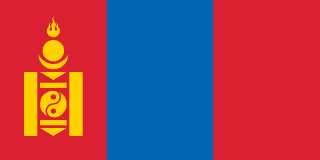
There's no especially close match for Mongolia's flag, the red-blue-red vertical stripes combined with the golden Soyombo symbol, an ancient emblem combining fire, sun, moon and other elements, make it genuinely distinctive worldwide, one of the more visually intricate national flags in use today.
The blue stripe and the Soyombo symbol have deep roots in Mongolian tradition, with the current version, minus a communist star removed in 1992, adopted after the fall of Soviet-aligned rule.
The least densely populated country on Earth, with vast open steppe and just over 2 people per square kilometre.
Play today's Flagpie →© Flagpie 2026