
Oceania
The Federated States of Micronesia is a scattered nation of over 600 islands in the western Pacific Ocean, sitting north of Papua New Guinea and east of Palau.
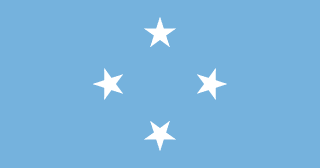
This flag has the highest proportion of sky blue of any flag in Flagpie, at 98%.
Micronesia's name comes from Greek, meaning 'small islands,' a descriptive term for the wider Pacific region encompassing thousands of small islands, later adopted specifically by the Federated States of Micronesia as its own national name.
Landscape: Made up of hundreds of islands across four states, mostly low coral atolls with some higher volcanic islands.
Climate: Tropical, warm and humid year-round with a wet season.
Food: Breadfruit, taro, and fish form the basis of traditional Micronesian cooking.
Palikir, on the island of Pohnpei, became the Federated States of Micronesia's capital in 1989, a purpose-built government centre chosen to avoid favouring any of the country's existing population centres. With a small population, it remains a primarily administrative site rather than a significant commercial hub.
The country's flag, featuring four stars representing its four states, Chuuk, Kosrae, Pohnpei, and Yap, is Micronesia's most significant unifying national symbol given the considerable cultural diversity across its scattered islands.
Yapese stone money, enormous carved limestone discs historically used as a form of currency and status symbol, remains one of the most distinctive traditional practices in the Pacific, some pieces still recognised as holding value within specific communities today. Traditional Micronesian navigation knowledge, passed down through specific master navigators without written charts, remains taught on some islands as living heritage.
Nan Madol, a mysterious ancient city built on artificial islets off Pohnpei using massive basalt stone columns, is a UNESCO World Heritage Site whose full construction purpose and methods remain only partially understood.
Micronesia's coral reefs, particularly around Chuuk Lagoon, site of a major Second World War naval battle, now serve as an accidental artificial reef system supporting extensive marine life around sunken wartime vessels. Pohnpei's rainforest interior remains one of the wettest places on Earth, supporting unique cloud forest vegetation found nowhere else in Micronesia.
Micronesia is majority Christian, and the country's culture varies significantly between its four states, each with distinct languages and traditions, unified politically but not culturally uniform.
Micronesia's economy relies significantly on fishing licence revenue and financial assistance under its Compact of Free Association with the United States, similar to the Marshall Islands's arrangement.
Independence Day on November 3rd marks 1986, when the Federated States of Micronesia's Compact of Free Association with the United States took effect, formalising its sovereignty. Given the country's significant Christian population, Christmas and Easter are both widely observed across its four states. United Nations Day is observed given Micronesia's history as a UN trust territory before independence. Yap Day celebrates the island's distinctive stone money culture with traditional dance.
Weightlifting and outrigger canoe racing both hold cultural significance in Micronesia, similar to other Pacific island nations, and traditional Yapese sports, tied closely to the island's distinctive stone money culture, remain practised as part of broader cultural heritage. Micronesian athletes have also competed in swimming at recent Olympic Games. Micronesian weightlifters have also competed at recent Pacific Games. Canoe racing remains a genuinely significant traditional pastime across the islands.
The Federated States of Micronesia is a presidential federal republic, with a President elected by Congress from among its members, given the country's four constituent states, Chuuk, Kosrae, Pohnpei, and Yap, each retaining significant independent authority. The country maintains a Compact of Free Association with the United States, providing financial assistance and defence arrangements in exchange for continued American military access. Micronesia's economy relies significantly on fishing licence fees and continued US financial assistance.
Nanlaud, on Pohnpei, is Micronesia's highest point at 782 metres. The lowest point sits at sea level across the country's scattered islands. Micronesia's terrain varies from high volcanic islands to low coral atolls across its scattered territory.
The United Nations's own flag is Micronesia's closest visual relative, both use a blue field, a deliberate design choice reflecting the country's history as a UN trust territory before independence, though Micronesia's four white stars, representing its states, replace the UN's olive branch emblem. The four-star design directly reflects the country's exact number of constituent states, unlike most star-based flags.
Adopted in 1978, its design deliberately echoes the flag of the United Nations, reflecting the country's history as a UN trust territory before independence.
Made up of 607 islands spread across more than 2.6 million square kilometres of ocean, despite having only around 700 square kilometres of land.
Play today's Flagpie →© Flagpie 2026