
Oceania
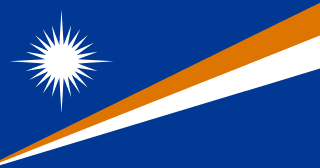
The Marshall Islands is a nation of atolls and islands in the central Pacific Ocean, sitting north of Nauru and Kiribati and east of Micronesia.
The Marshall Islands's name comes from British explorer John Marshall, who charted parts of the archipelago in the 1780s, a name that stuck despite the islands having been inhabited by Micronesian peoples for thousands of years before European contact.
Landscape: A chain of low coral atolls and islands spread across the central Pacific, with very little land above sea level.
Climate: Tropical, warm year-round with a wet season.
Food: Fish and breadfruit are staples, alongside coconut-based dishes reflecting the limited arable land.
Majuro, an atoll made up of numerous small islets around a large lagoon, functions as the Marshall Islands's capital, with a population of around 27,000 concentrated on a narrow strip of land. The atoll's limited land area makes it, like Kiribati's capital, particularly vulnerable to rising sea levels.
The frigate bird and traditional stick charts, an Indigenous Marshallese navigation tool made from woven sticks and shells representing wave patterns and islands, are both closely tied to the country's deep maritime heritage.
Marshallese stick chart-making, a genuinely sophisticated traditional navigation technology used for open-ocean wayfinding long before modern instruments, is a UNESCO-recognised craft, and traditional handicrafts using pandanus and coconut fibre remain widely produced. Traditional Marshallese canoe-building, producing outrigger vessels capable of long ocean voyages, remains taught to preserve the islands' navigational heritage.
Bikini Atoll, site of numerous US nuclear weapons tests in the 1940s and 50s, remains uninhabited today and is a UNESCO World Heritage Site specifically as a site of historical memory regarding the nuclear age.
The Marshall Islands's surrounding waters, including within the Bikini Atoll lagoon, have seen coral reefs recover significantly since nuclear testing ended, now supporting notable marine biodiversity including large shark populations.
The Marshall Islands is majority Christian, predominantly Protestant, and the country's culture remains deeply tied to traditional land tenure and navigation knowledge passed down through specific families for generations. The Marshall Islands has pursued significant international advocacy on climate change, given its islands sit barely above current sea level.
The Marshall Islands's economy relies significantly on fishing licence revenue and financial assistance tied to its Compact of Free Association with the United States, given its very limited formal export base.
Constitution Day on May 1st marks 1979, when the Marshall Islands adopted self-governance under its current constitution ahead of full independence. Given the Marshall Islands's significant Christian population, Christmas and Easter are both widely observed, and Nuclear Victims Remembrance Day in March commemorates those affected by decades of US nuclear weapons testing on the islands. Fishermen's Day recognises the traditional importance of fishing to Marshallese coastal communities.
Weightlifting and outrigger canoe racing both hold significant cultural roles in the Marshall Islands, the latter closely tied to the country's deep traditional navigation heritage. Basketball has also grown in popularity given broader Pacific and American cultural influence. Marshallese athletes have also competed in judo at recent Olympic Games.
The Marshall Islands is a presidential republic, with a President serving as both head of state and government, elected by parliament. The country maintains a Compact of Free Association with the United States, providing significant financial assistance and defence arrangements in exchange for continued American military access, a relationship rooted in the islands' history as a US-administered nuclear testing site. The Marshall Islands operates a significant international ship registry, generating revenue despite the country's small size.
The Marshall Islands's highest point sits at just 10 metres above sea level, one of the lowest national high points in the world, reflecting the country's low-lying coral atoll geology. The lowest point sits at sea level throughout the archipelago. The Marshall Islands's low-lying atolls face significant existential risk from continued sea level rise.
There's no especially close match for the Marshall Islands's flag, the orange and white diagonal stripes against blue, topped by a 24-point star, are a distinctive combination, that star's rays specifically representing the country's municipalities in a way unique to the Marshall Islands's own design. The 24-point star design is genuinely unique among all Pacific Island nations' flags.
Designed by Emlain Kabua.
Adopted in 1979, the diagonal orange and white stripes are meant to represent growth and peace.
Made up of over 1,000 individual islands and islets spread across the Pacific.
Play today's Flagpie →© Flagpie 2026