
Asia
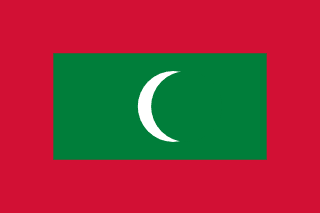
The Maldives is a chain of atolls in the Indian Ocean, sitting southwest of India and Sri Lanka, and the lowest-lying country on Earth.
The Maldives's name likely comes from Sanskrit, roughly meaning 'garland of islands,' a fitting description for the nation's roughly 1,200 coral islands arranged in a series of ring-shaped atolls.
Landscape: A chain of coral atolls in the Indian Ocean, the lowest-lying country on Earth, with almost no land more than a couple of metres above sea level.
Climate: Tropical, warm year-round with a wet monsoon season.
Food: Garudhiya, a fish soup typically served with rice, lime, and chilli, is a genuine everyday staple.
Malé has served as the Maldives's capital for centuries, historically the seat of the country's sultanate, and remains one of the most densely populated islands on Earth, with a population of around 250,000 packed into just a few square kilometres. Land reclamation has significantly expanded the city's footprint in recent decades to accommodate growth.
The yellowfin tuna, central to the Maldivian diet and economy for centuries, is closely tied to national identity, and the pink rose, though not native, is the country's official national flower.
Maldivian lacquer work, producing intricately decorated wooden boxes and containers, is a distinctive local craft, and traditional Maldivian boat-building, producing the dhoni, a wooden sailing vessel still used for fishing and transport, reflects the country's deep maritime heritage. Traditional Maldivian bodu beru drumming and dance performances remain a genuinely popular form of community entertainment and cultural expression.
The Maldives itself, as the lowest-lying country on Earth, functions as its own most significant landmark, with its overwater bungalow resorts having become internationally iconic, alongside the historic Hukuru Miskiy, a 17th-century coral-stone mosque in Malé.
The Maldives's coral reefs support whale sharks, manta rays, and extraordinary marine biodiversity, though rising sea temperatures have caused significant coral bleaching events in recent decades, a serious ongoing concern for the reef ecosystem.
The Maldives is officially and entirely Muslim by law, one of relatively few countries where Islam is constitutionally mandated for all citizens, and the country's culture reflects a blend of South Asian, Arab, and East African influences shaped by its historic trading position.
The Maldives's economy relies overwhelmingly on tourism and fishing, particularly tuna, rather than significant manufactured goods exports, given the country's limited land area and resources.
Independence Day on July 26th marks 1965, when the Maldives gained sovereignty from British protection. Given the Maldives's status as an entirely Muslim nation by law, Eid al-Fitr and Eid al-Adha are both major national holidays, and Republic Day in November marks the country's 1968 transition from a sultanate to a republic. The Maldives's Fisherman's Day in December honours the industry historically central to the country's economy.
Football holds the largest domestic following in the Maldives by a wide margin, and given the country's extraordinary marine environment, diving and water sports draw significant international attention, forming a central part of the Maldives's global tourism identity. Maldivian swimming has grown given the country's natural marine environment.
The Maldives is a presidential republic, with a President serving as both head of state and government. The country's low-lying geography, the lowest maximum elevation of any nation on Earth, has made it a particularly prominent voice in international climate change discussions, given the existential threat rising sea levels pose to its very existence. The Maldives's tourism industry, built around its luxury overwater resorts, forms the overwhelming majority of the national economy. The Maldives's fishing industry, alongside tourism, remains a vital part of the national economy.
The Maldives's highest point sits at just under 5 metres above sea level, giving it the lowest high point of any country in the world, a genuinely striking geographic distinction. The lowest point sits at sea level throughout the archipelago's roughly 1,200 low-lying coral islands. The Maldives's extremely low-lying terrain makes it one of the most climate-vulnerable nations in the world.
There's no especially close match for the Maldives's flag, the red border framing a green rectangle with a white crescent is a distinctive combination, though the crescent-and-Islamic-symbolism theme is broadly shared with several other Muslim-majority nations, none arranged in quite the same rectangular-within-border layout.
The red and green design has roots in earlier Maldivian flags used for centuries, formalised into the current design in 1965.
The lowest-lying country on Earth, with an average elevation of only about 1.5 metres above sea level.
Play today's Flagpie →© Flagpie 2026