
Asia
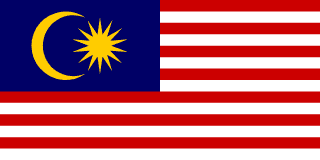
Malaysia is split into two regions in Southeast Asia, a peninsula bordering Thailand to the north, and a portion of the island of Borneo bordering Indonesia and surrounding Brunei.
Malaysia's name derives from the Malay people, the region's dominant ethnic group, with 'Malay' itself possibly tracing back to an ancient kingdom called Melayu on the island of Sumatra.
Landscape: Split between Peninsular Malaysia and the states of Sabah and Sarawak on Borneo, both heavily forested and mountainous.
Climate: Tropical, hot and humid year-round with a monsoon season.
Food: Nasi lemak, coconut rice served with a range of accompaniments, is widely considered the national dish, reflecting Malaysia's mix of Malay, Chinese, and Indian culinary traditions.
Kuala Lumpur, whose name means 'muddy confluence,' grew from a small tin-mining settlement at the meeting point of two rivers in the 1850s into Malaysia's capital and largest city. With a population of around 1.8 million in the city itself, it's known for the Petronas Towers, once the tallest buildings in the world.
The hibiscus is Malaysia's national flower, chosen in 1960 partly for its five petals, said to represent the country's national principles. The Malayan tiger, critically endangered, is the national animal and appears on the country's coat of arms.
Batik, a wax-resist dyeing technique shared with neighbouring Indonesia, is a significant Malaysian craft tradition, and traditional Malay weaving, particularly songket cloth woven with gold or silver threads, remains produced for formal occasions.
The Petronas Towers in Kuala Lumpur, completed in 1998, remain among the tallest twin towers in the world, and George Town on Penang Island, reflecting a mix of colonial and Chinese, Malay, and Indian influences, is a UNESCO World Heritage Site. The Batu Caves, a limestone hill containing Hindu temples and a giant golden statue at its entrance, are among the most visited religious sites in the country.
The Malayan tiger, found only on the Malay Peninsula, is critically endangered, with fewer than 200 believed to remain in the wild, and Malaysian Borneo is home to orangutans and one of the world's most biodiverse rainforests. Malaysian Borneo's rainforests are also home to the proboscis monkey, recognisable by its unusually large nose and found nowhere else in the world.
Malaysia is majority Muslim, predominantly ethnic Malay, alongside significant Chinese and Indian populations practising Buddhism, Christianity, and Hinduism respectively, making it one of the more religiously and ethnically diverse countries in Southeast Asia.
Malaysia is a significant exporter of electronics and semiconductors, palm oil, of which it's one of the largest global producers, and petroleum products.
National Day (Merdeka Day) on August 31st marks 1957, when the Federation of Malaya gained independence from Britain, and Malaysia Day on September 16th marks the later 1963 formation of the wider federation including Sabah, Sarawak, and Singapore, the latter of which left in 1965. Given Malaysia's religious diversity, the country observes an unusually broad range of holidays across Islamic, Buddhist, Hindu, and Christian traditions, all recognised nationally. Thaipusam, a Hindu festival involving elaborate body piercing as an act of devotion, draws enormous crowds at the Batu Caves each year.
Badminton holds a genuinely central place in Malaysian sporting culture, the country having produced some of the sport's most successful international competitors and treating it with a level of national attention comparable to football elsewhere. Sepak takraw, combining elements of football and volleyball, and football itself both also draw significant domestic followings.
Malaysia is a federal constitutional monarchy, with a King (Yang di-Pertuan Agong) elected every five years on a rotating basis among the country's nine hereditary state rulers, a genuinely unusual system found nowhere else in the world. Real day-to-day executive power sits with a Prime Minister accountable to a bicameral Parliament.
Mount Kinabalu, in Malaysian Borneo, is the country's highest point at 4,095 metres, and is one of the most biologically diverse mountains on Earth, home to thousands of plant species found nowhere else. The lowest point sits at sea level across Malaysia's territory, split between the Malay Peninsula and northern Borneo.
The United States's flag is the closest match to Malaysia's by structure, both use horizontal red-and-white stripes with a blue canton carrying stars, though Malaysia's canton additionally includes a crescent moon, and the exact star count and stripe number differ between the two. Singapore's flag also carries a crescent and stars on a different colour base, similar in symbolic content though visually distinct enough from Malaysia's striped design.
Designed by Mohamed Hamzah.
Adopted in 1963 when Malaysia expanded to include Sabah and Sarawak, based on an earlier 1950 design for the Federation of Malaya, with stripes and star points added to reflect the growing number of states.
One of the most biodiverse countries on Earth, with over half its land still covered in forest.
Play today's Flagpie →© Flagpie 2026